How a localized strategy secured Top 5 rankings in the German travel market
- Overview:
- The German Market for Travel and Local Apps
- The Challenge: Indexed But Unseen
- Campaign Structure: A Dual-Language and Category Approach
- The 14-Day Execution Roadmap
- Data and Performance Analysis
- Conclusions and Practical Takeaways
Summer travel is at its peak, but a popular German road trip app hit a common growth wall. The app had all the right keywords in its metadata, but it ranked below position 40 for its main searches, leaving it too far down the page for users to actually find it.
To solve this, we set up a 14-day promotion plan that paired category installs with a dual-language keyword installs. Instead of focusing only on German queries, we also included the high-volume English searches frequently used by international travelers. After two weeks, the app entered the top 5 for its main keywords and reached position 4 in the Travel & Local category charts.
The German Market for Travel and Local Apps
Mobile app usage in Europe is highly concentrated, specifically within the travel and navigation sectors. Germany currently operates one of the most mature app economies in Europe. Grand View Research states that in 2024, the national mobile app market generated over $12.6 billion in revenue, driven by active and highly selective smartphone consumers.
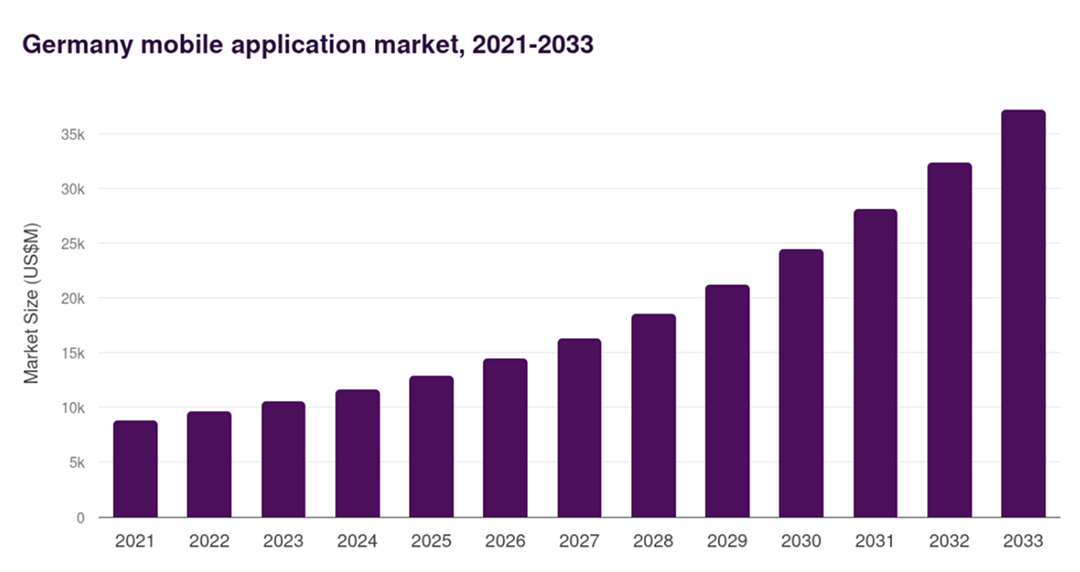
The Travel & Local category sees massive demand especially in the summer months as European consumers plan their trips. According to Q2 2025 data from Sensor Tower, top German travel apps like DB Navigator consistently get 40,000 to 51,000 weekly downloads and maintain about 6.7 million active users. Niche routing and parking apps like EasyPark also hit major spikes, reaching up to 42,000 downloads in mid-June as the summer travel rush begins. Outdoor navigation tools like Outdooractive and OsmAnd experience similar boosts in both revenue and active users during this exact window.
In reality, well-built apps often hit a wall if they lack a strong history of installs. The top spots for popular keywords like “campingplatz” are locked down by older products that have dominated the charts for years. Because the Google Play algorithm heavily rewards past performance, newer apps usually face a tough climb. Even if your metadata is flawlessly optimized, your ranks will not improve without a solid base of existing installs to prove your product’s relevance to the store.
The Challenge: Indexed But Unseen
Our client’s app had a clear purpose in the crowded Travel & Local category: helping users plan campervan road trips across Germany. A few months after launch, the app’s store listing looked great, with clean metadata and well-chosen keywords. However, the actual ranking data was a bit disappointing. The app remained at position 47 for “campingplatz” and 51 for “reiseroute erstellen”. For English keywords, it sat even lower, hovering at position 58 for “camping app” and 65 for “road trip planner”.
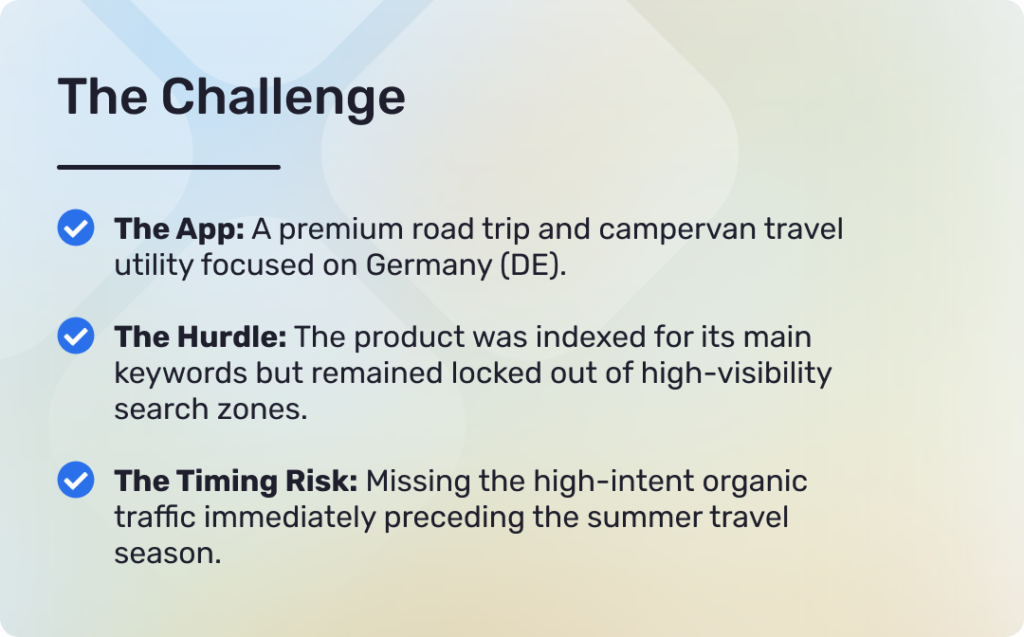
None of these rankings actually brought in organic traffic. In the Travel & Local category, an app needs to break into the top 10 just to get seen. Sitting at position 47 for a popular keyword results in almost zero daily installs. The issue was not the app’s metadata, as the keywords were already set up perfectly. The real goal was to give the store algorithm the right volume signal to move the app up the charts before the summer travel season ended. Missing this short window meant waiting a full year for the next big wave of seasonal users.
Campaign Structure: A Dual-Language and Category Approach
We designed the promotion around a fundamental rule of European search behavior. Focusing exclusively on native language keywords in regions like Germany ignores a massive segment of the audience. Many users in European markets search in English, especially when planning international road trips or utilizing global planning tools. A comprehensive strategy covers both behaviors.
The promotion relied on a 14-day localized plan divided into two distinct keyword groups:
- English Queries (Global Intent): “camping app”, “road trip planner”
- Native Queries (German Intent): “campingplatz”, “reiseroute erstellen”
We paired our keyword strategy with a category promotion to get faster results. We directed 1,000 to 1,500 daily installs to the Travel & Local – Top Free category to build trust with the Google Play algorithm. Because climbing the main category charts shows that an app is highly relevant, the store became much more willing to boost our rankings for individual search phrases.
The 14-Day Execution Roadmap
Over the 14-day campaign, we gradually increased the daily install volume. Proper pacing ensures that the app keeps its new ranking longer after the promotion ends rather than dropping off right away. Category installs provided the primary algorithmic support. As the category rank climbed from position 48 to 4, the algorithm recognized the app as a rapidly growing product.
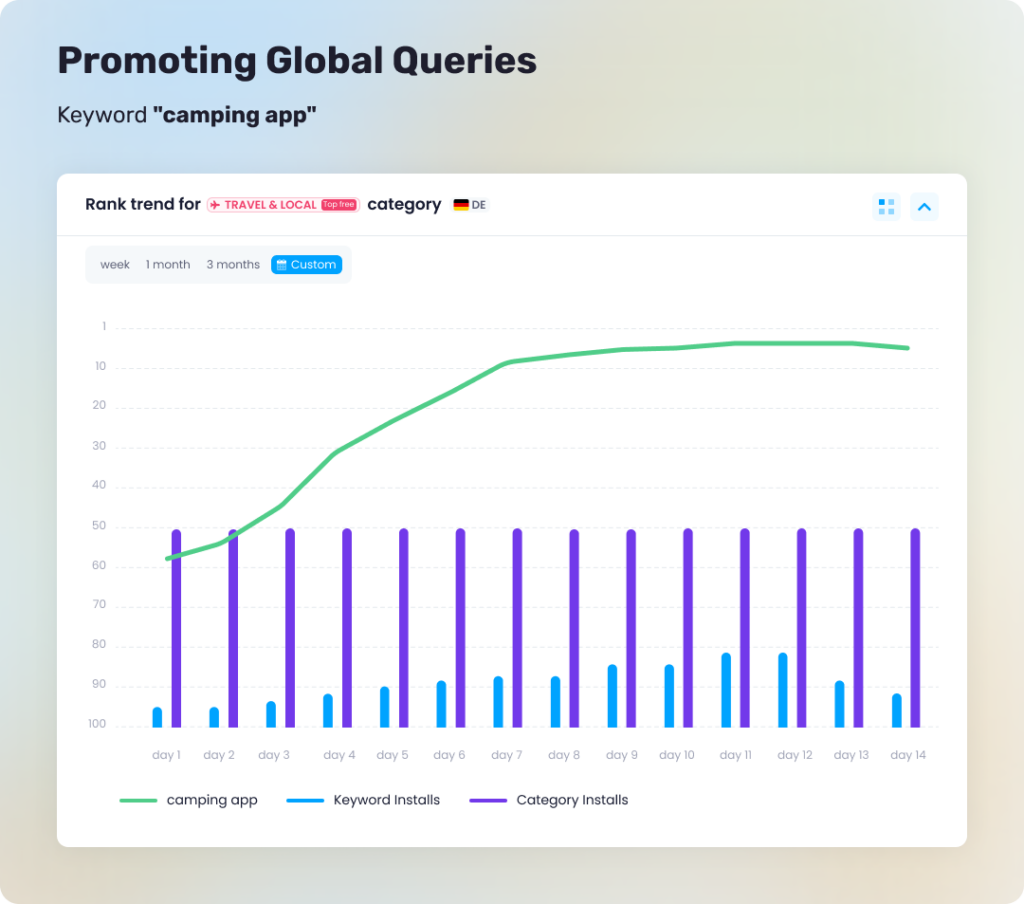
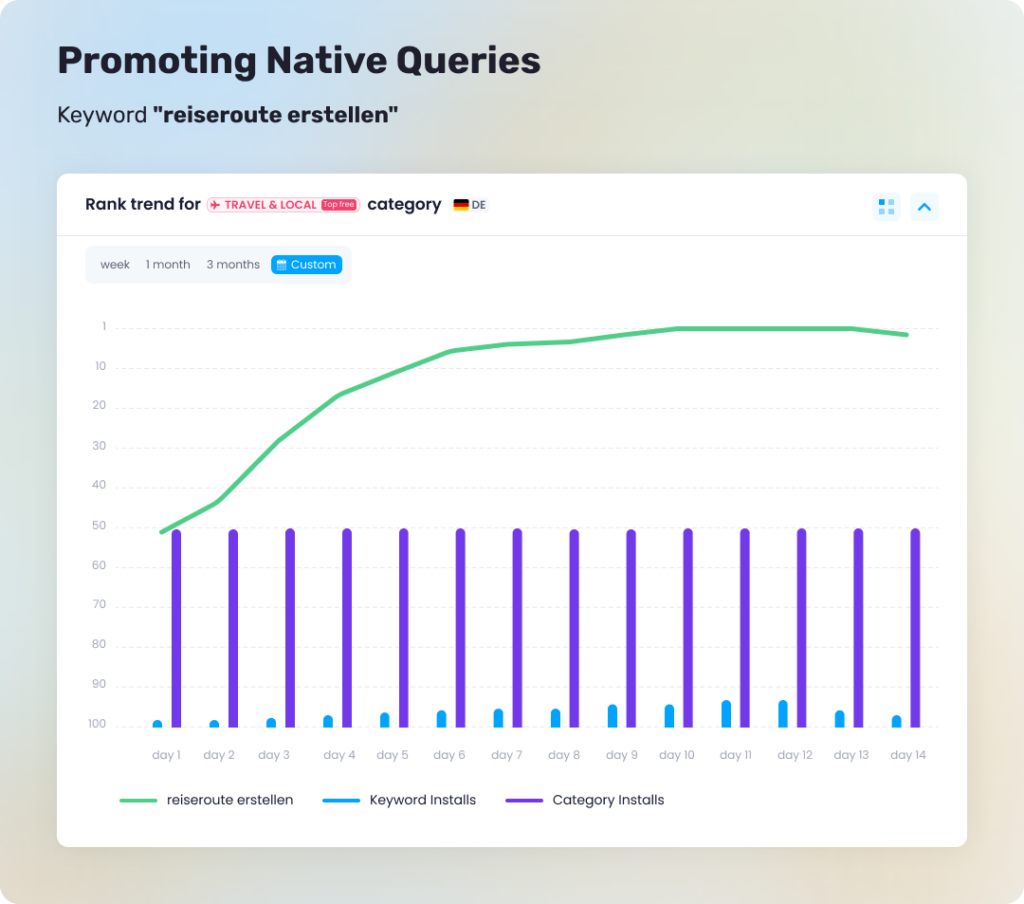
During Phase 1 (Days 1 to 4), the goal was introduction. We chose small install volumes, and by Day 3, we saw clear progress: “campingplatz” advanced from position 47 to 30, and “reiseroute erstellen” moved from 51 to 29. The English keyword “camping app” also improved from 58 to 44. This early movement confirmed the store was actively registering our traffic.
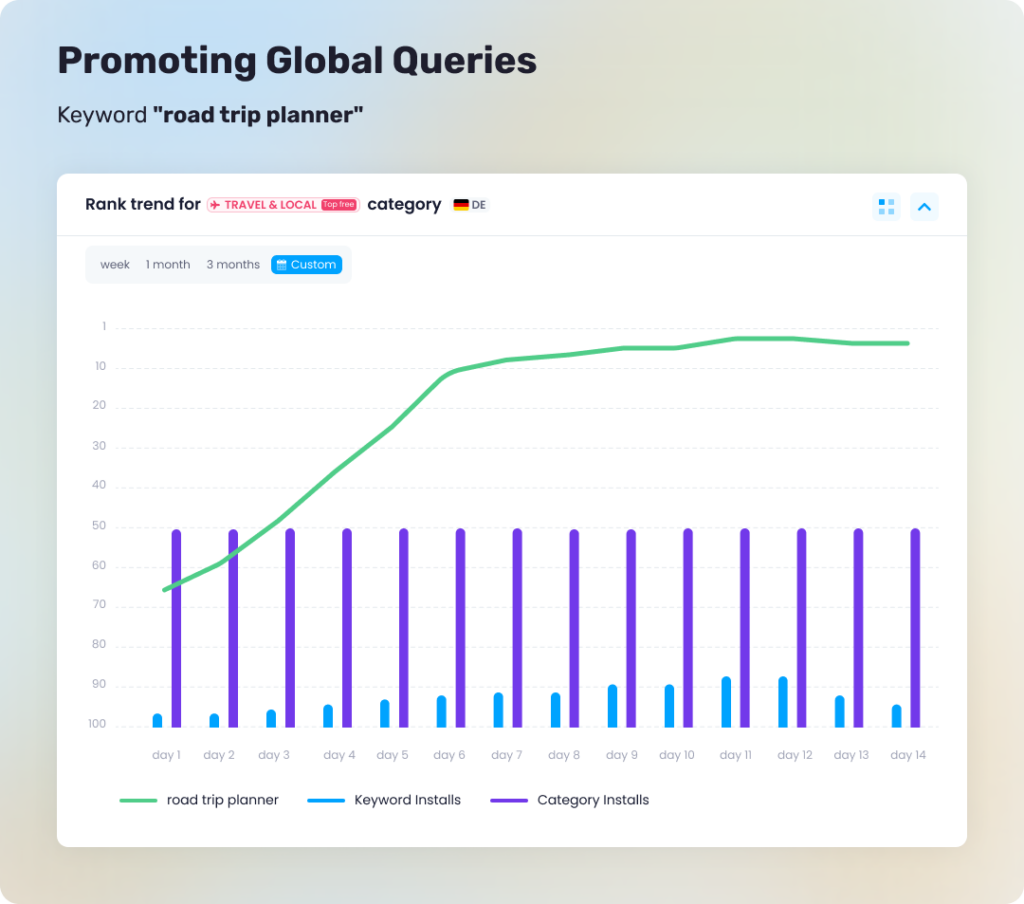
Phase 2 (Days 5 to 9) focused on breaking into the critical top 10. Install volumes peaked during this window. Displacing established competitors takes a strong, sustained signal, making this the most resource-intensive phase. The effort succeeded: by Day 7, “campingplatz” entered the top 5, “reiseroute erstellen” reached position 4, and “camping app” secured position 9.
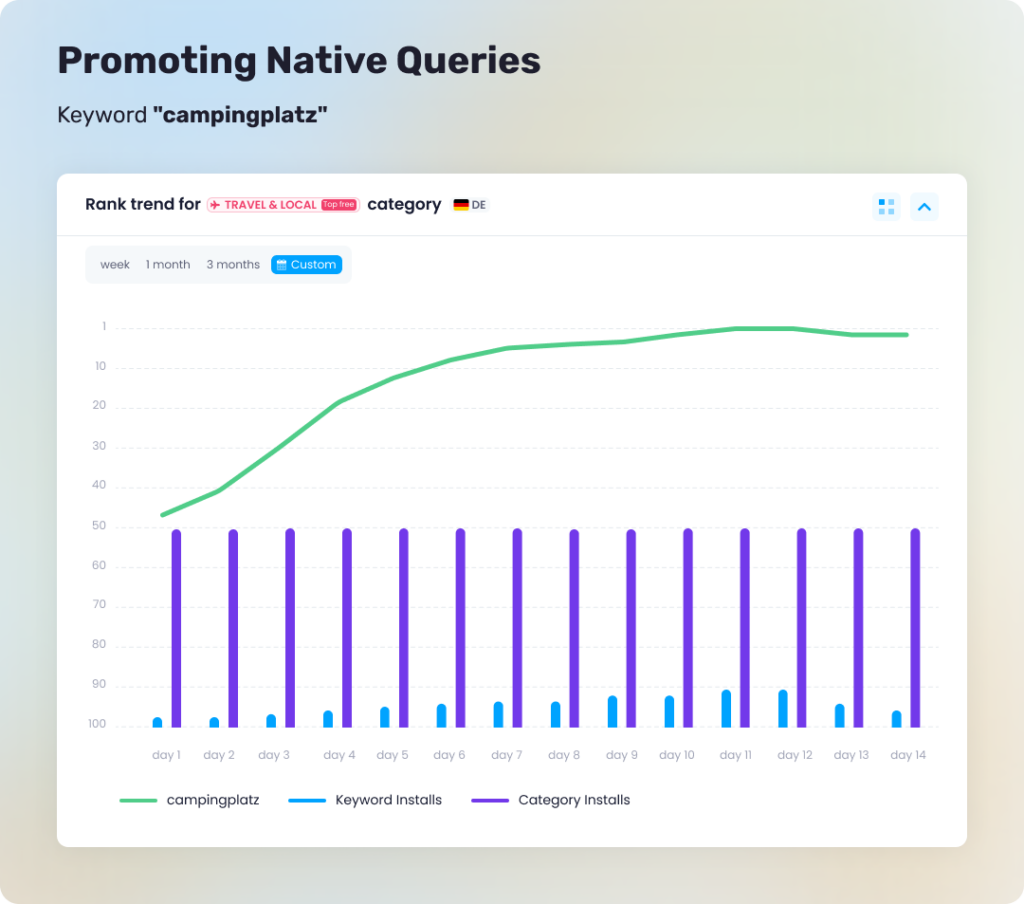
Finally, Phase 3 (Days 10 to 14) centered on position consolidation. We slowly lowered the daily volume to simulate a natural leveling off of traffic. Even with fewer daily installs, the rankings held strong or continued to improve. On Day 10, “reiseroute erstellen” briefly hit position 1, while “campingplatz” locked in position 2. By the final day, “road trip planner” had successfully settled at position 3.
Data and Performance Analysis
By the end of the promotion, every keyword moved into its target position. The strategic pacing and dual-language approach paid off across the board. The app successfully secured high rankings just in time for the summer season.
Here are the final results after the 14-day period:
- “camping app”: moved from position 58 to position 4.
- “road trip planner”: moved from position 65 to position 3.
- “campingplatz”: moved from position 47 to position 2.
- “reiseroute erstellen”: moved from position 51 to position 2.
The rapid rise up the category chart ensured that the newly acquired positions remained secure for a while. The app transitioned from an invisible utility to a top 5 for its most important search keywords.
Conclusions and Practical Takeaways
The data from this campaign reveals clear patterns for scaling apps in competitive European markets. Here is what you need to know:
- Acknowledge the dual-language reality. Focusing only on native languages in Europe ignores a massive audience. English searches carry high intent and happen daily. Promoting keywords in both languages simultaneously expands your reach and secures users that competitors often miss.
- Combine category and keyword installs. Running 1,000 to 1,500 daily installs to the category charts gave the algorithm the exact proof it needed. A higher category rank shows the store your app is relevant, which directly boosts your keyword progress. For the best results in competitive niches, we always prefer pairing this category growth with keyword installs.
- Pace your installs gradually. The ranks we achieved did not drop off immediately after the campaign ended. This success ties directly to our pacing strategy. Store algorithms look for natural growth patterns. Gradually increasing your install volume looks like real organic interest, resulting in ranks that last.
To sum up, a well-defined semantic core is a prerequisite, not a substitute. This strategy worked because the app’s metadata was already solid. Installs provide the necessary volume, but the algorithm needs well-structured metadata to understand what that volume means. You absolutely need both to achieve strong organic ranks.
If your app has strong metadata but stagnant ranks, the Keyapp.top team can help. We will review your current metrics, analyze your app, and build a custom promotion plan to meet your exact goals. Contact our support team to discuss your strategy!