

July’26 – Google Play reporting, Catalog Access, App Store age ratings, and AI content labeling.
- Overview:
- Google Play’s Reporting Finally Catches Up
- Google Opens the Catalog to Rival Stores
- Age Checks and AI Labels Are the New Baseline
- Apple Tightens the Screws on Trust and Safety
- The Money Behind the Month
- To Sum Up: More Apps, Same Amount of Attention
July settled several disputes that had been building since spring. Google Play moved its store listing reports from confirmed installs to raw clicks, then followed with a court ordered Catalog Access Program letting approved third-party US Android stores pull listings straight from Google Play starting July 22. Google also rolled out an Age Signals API for sharing user age ranges, and Google Ads began requiring AI asset labeling in some regions.
Apple’s fiscal third-quarter earnings put a number on a story ASO teams have watched all year, and its Age Ratings page quietly went from one global number to a rating per country. Trust and safety pressure at both stores kept coming from outside rather than from either company’s own initiative. None of these stories reads like an algorithm update, but each one changes what your next quarterly report needs to explain.
Google Play’s Reporting Finally Catches Up
The biggest change inside the Play Console this month is not a new feature, it is a change in what counts as success. Starting in July, Google began measuring store listing performance by unique clicks on the Install, Open, or Pre-register buttons instead of confirmed acquisitions, according to Google Play Console Help. Install numbers have not gone anywhere, they are still on the Grow users overview page, in Statistics, and in downloadable reports, so nothing you built your reporting around needs to be thrown out, it just moved down in priority.
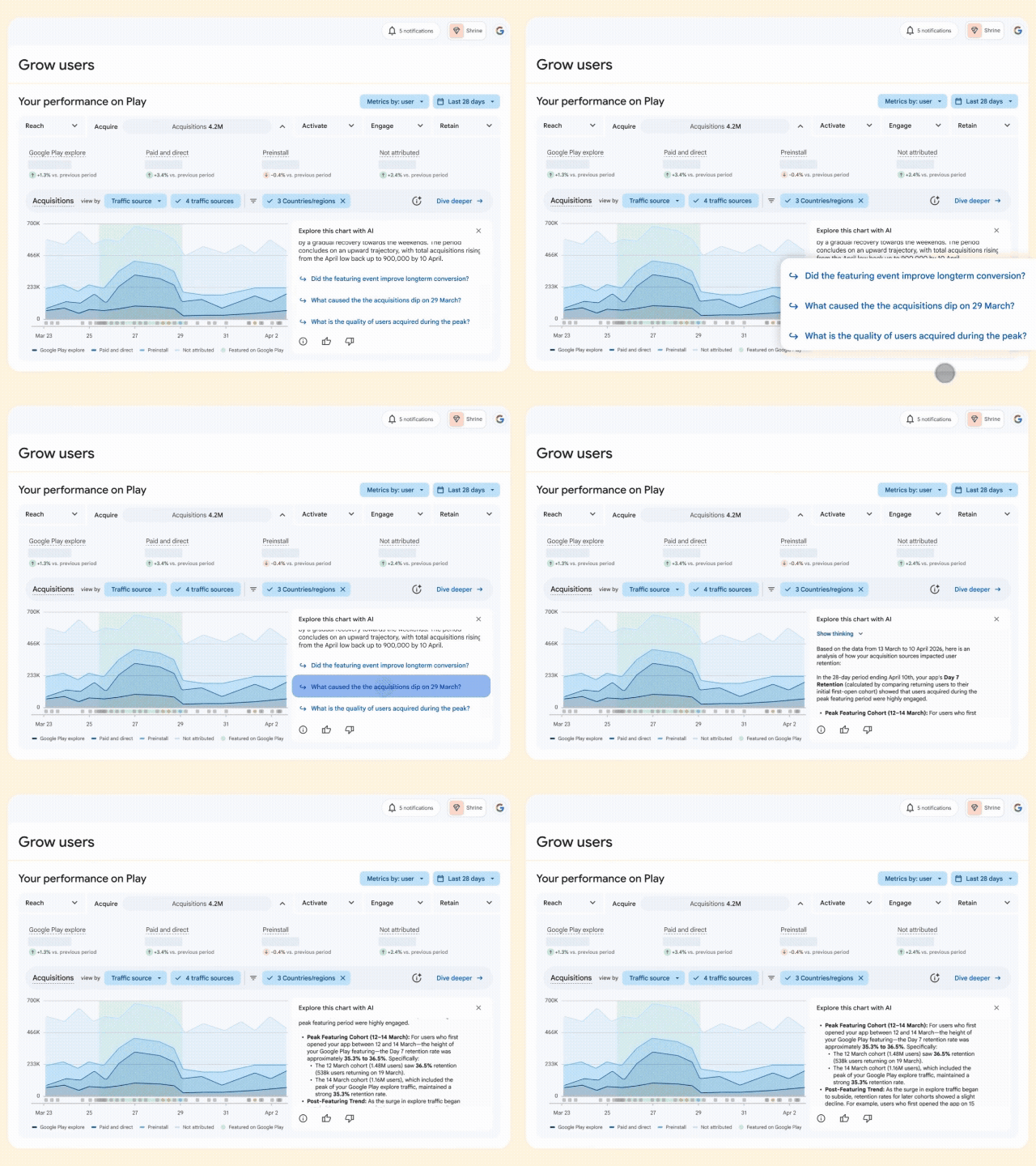
Google paired that change with an AI layer on top of it. Chart descriptions and interactive Q&A are now built into the Statistics, Reach and Devices, and Store Performance pages, so instead of reading a dip on the Grow users dashboard and guessing why, you can ask directly what caused it, according to Google Play’s Q2 2026 recap. A similar apps module now sits directly under the Install button, A/B testing dropped from three variants to two, and custom listings can no longer target inactive or former users, all tightening what used to be a fairly loose testing setup.
Google Opens the Catalog to Rival Stores
The bigger discovery story did not come from a product update at all. On July 22, Google’s Play Catalog Access Program went live, letting approved third-party US Android app stores pull listings, meaning names, icons, descriptions, screenshots, and videos, straight from Google Play, according to Google Play Console Help. Developers who had not made an explicit choice by that date were enrolled by default in the broadest sharing option, according to Tech Times. Downloads still route through Google Play and carry its usual fee, so this is a court ordered settlement tied to the Epic v. Google case, not a workaround for Play’s business model. For ASO teams, this means one optimized listing can now show up in storefronts you have never tested, and your keyword and category performance becomes the one signal that travels with it, wherever it lands.
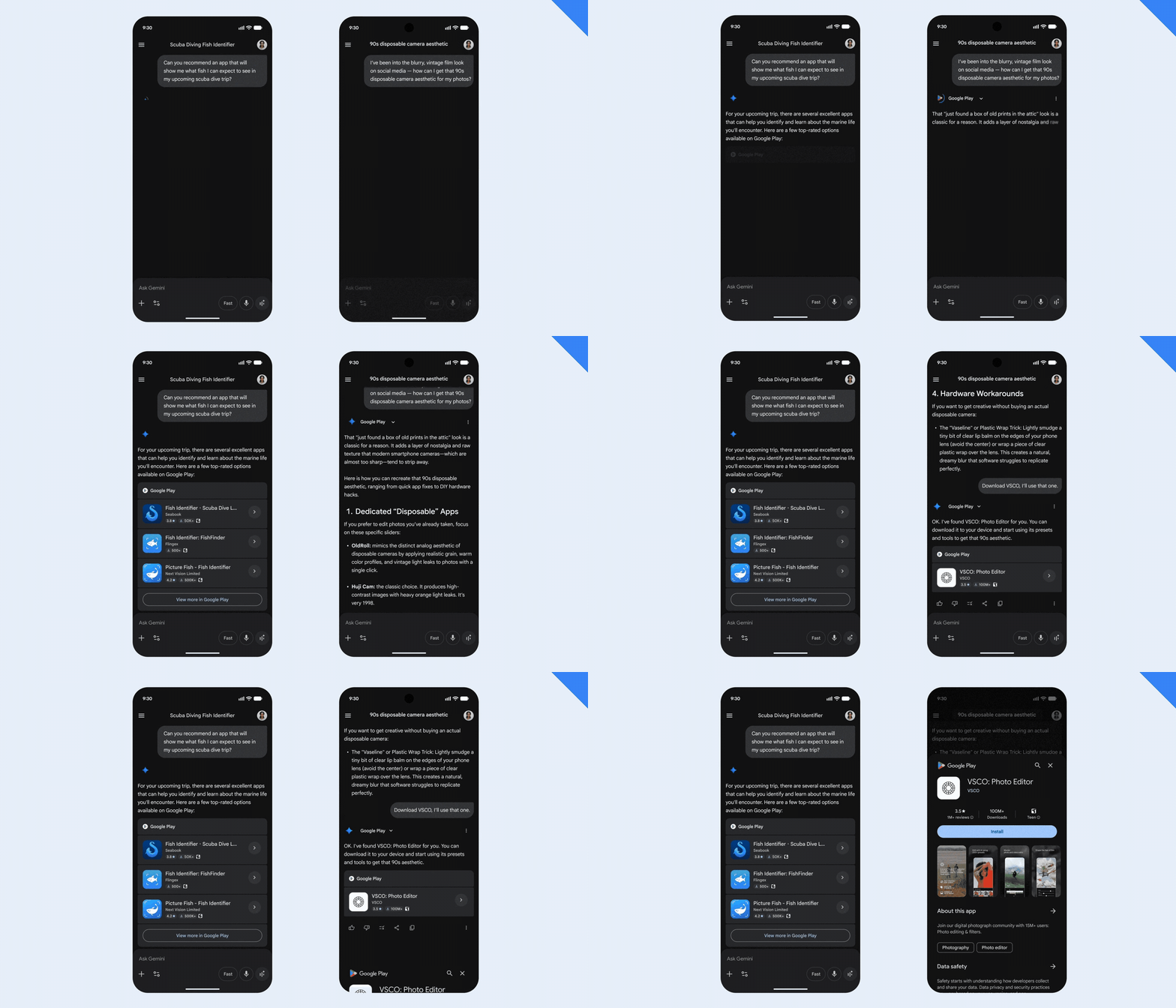
The same quarter, Google introduced Ask Play, a conversational search overlay that lets shoppers type a real question, such as finding an app to identify fish before a scuba trip, and get a direct recommendation instead of a list of keyword matches, according to Google Play’s Q2 2026 recap. Ranking for a keyword only helps if your metadata also answers the kind of question a shopper would actually ask. Separately, Play Store v52.3 added an EU label for AI-generated images, according to 9to5Google.
Age Checks and AI Labels Are the New Baseline
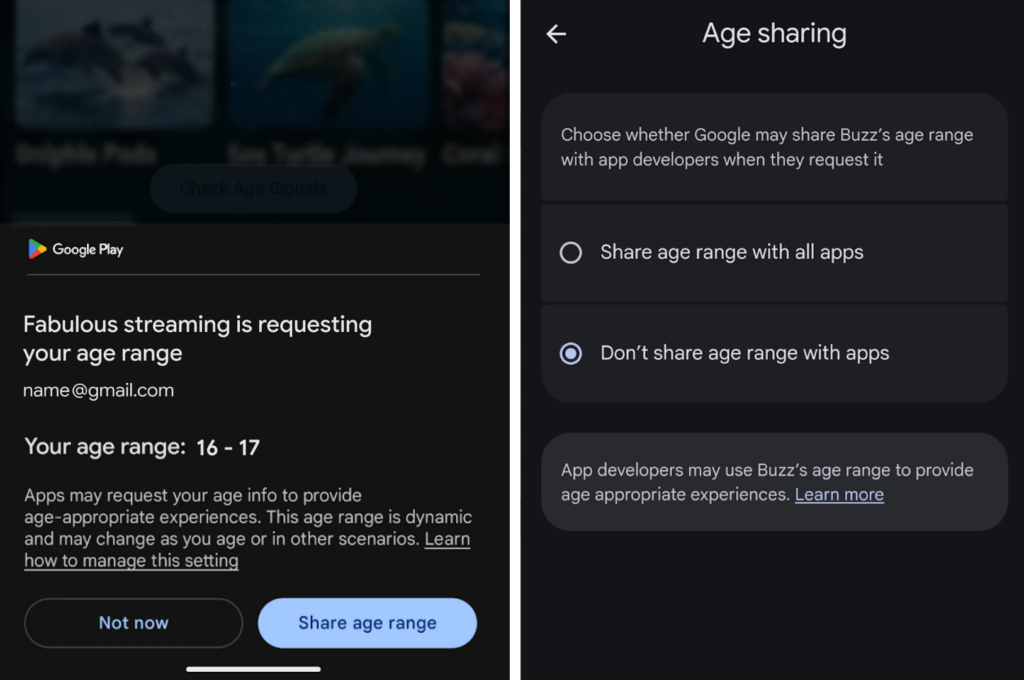
Google also rolled out the Play Age Signals API this month, letting apps request a user’s age range through a simple sharing prompt instead of inferring it from account data, according to the Android Developers Blog. It launched first in Brazil on July 29, with Australia and Canada following by mid-August. Sharing is off by default: a separate Age Sharing setting, managed through Google Family Link, lets a parent choose between sharing an age range with all apps or none, and only when that is turned on does a specific app’s request, like the one shown below, actually go through.
On the advertising side, Google Ads began rolling out an AI asset declaration setting this month, letting advertisers flag when an image or video creative was generated or edited with AI, according to Google’s Ads policy help center. The setting is arriving across Google Ads, Display & Video 360, Campaign Manager 360, Merchant Center, and Ads Editor, and labeling becomes required for AI-generated or edited assets running in the EU, India, and New York, so it is worth checking your creative pipeline before the next upload.
Apple Tightens the Screws on Trust and Safety
Apple’s July changes centered on accountability. The age rating questionnaire in App Store Connect started asking whether an app includes social media capabilities, defined as the ability to redistribute, amplify, or interact with user generated content through a feed or similar discovery method, according to Apple’s WWDC26 App Store guide. Apps that qualify get sorted into a new Social Media Time Allowance category with a minimum age rating of 13. Answering is optional in July but becomes mandatory in September, so it makes sense to answer now rather than scramble later.
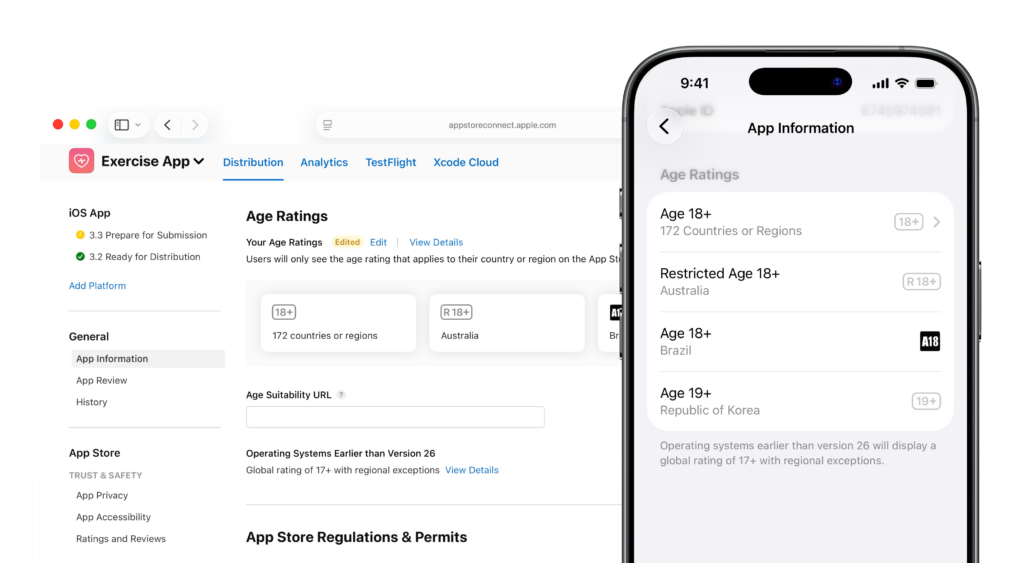
The Age Ratings page in App Store Connect changed shape alongside that questionnaire. Instead of one global number, your answers now generate a rating per country or region, such as 18+ across most of the world, R 18+ in Australia, A18 in Brazil, and 19+ in South Korea, according to Apple’s guide to setting an app age rating. Devices on an OS earlier than version 26 still fall back to a single blanket 17+, so the split only becomes visible on iOS 26 or later.
The Money Behind the Month
Apple’s fiscal third-quarter results, reported July 30, put real numbers behind a story that has been building all year. Revenue hit a June-quarter record of $109.4 billion, up 16 percent year over year, but Services revenue of $30.74 billion fell short of Wall Street’s $31.22 billion estimate, according to Apple’s own earnings report and TechCrunch. CFO Kevan Parekh pointed to a slowdown in mobile gaming and to the ongoing US court order on external link commissions, a case the Supreme Court agreed in June to hear, per 9to5Mac. Even with the miss, the App Store set a June-quarter record, and Services passed 1.5 billion paid subscriptions.
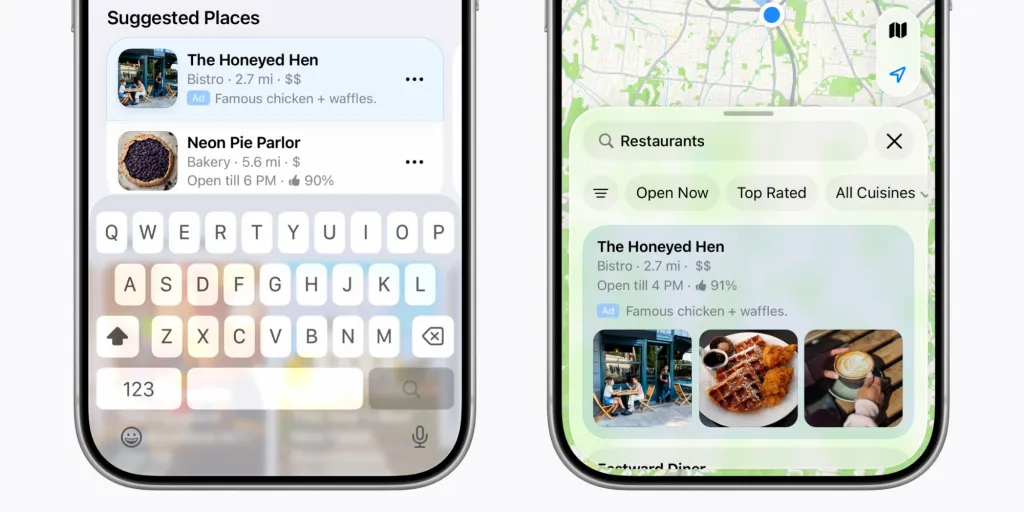
Apple Ads kept growing as a revenue line and is set to expand into Apple Maps for US and Canada users this summer, with a single sponsored listing appearing at the top of search results and inside the Suggested Places panel, tagged with a small “Ad” label, according to 9to5Mac. Separately, Apple quietly rewrote a clause in its Advertising Services Terms of Service, effective July 28, dropping language that limited ad delivery to its own software and devices, according to PPC Land, a contractual opening rather than a confirmed launch. Developers in Brazil, meanwhile, had until July 6 to accept an updated license agreement opening alternative distribution and payment there, according to Apple’s own guidance, part of the same regulator driven pattern reshaping both stores over two years.
To Sum Up: More Apps, Same Amount of Attention
None of this is happening in a quiet corner of the market. Worldwide, new app launches were up 60 percent year over year as of the first quarter of 2026 across both stores combined, and 80 percent higher on iOS alone, according to Appfigures data reported by TechCrunch. AI-assisted coding tools are the main reason given, lowering the bar enough that first-time developers now publish next to teams that have been building apps for years. Cleaner Play Store data, stricter Apple review, a shared catalog on Android, and new disclosure rules for age and AI all matter more, not less, as the number of apps chasing visibility keeps climbing.
August will likely be the first full month developers actually work inside these new defaults, the click based Play Console reports, the age signals prompts, and the AI labeling rules, instead of reacting to the announcements. That is usually when the real friction shows up.