
How a keyword installs campaign secured Top 10 positions in a highly competitive market
- Overview:
- French Mobile Market for Photo & Video Apps
- The Challenge: Well-Built, But Stuck
- Campaign Structure: A Tiered Keyword Approach
- Results
- Conclusions and Practical Takeaways
Six months after launch, a Photo & Video app in the French market had done most things right. Its metadata was well-structured, and its semantic core was solid. It also had a clear niche, focusing on analog and film filters with a distinct visual appeal. We stepped in to help this app right before the summer season, a period when this specific niche sees massive user demand. Yet its keyword positions had flatlined. It could not break into the top 10 for the high-volume keywords that actually drive installs. Meanwhile, its lower-tier positions were respectable but failed to generate meaningful organic traffic.
This case study documents how a structured keyword install campaign moved six target keywords from scattered mid-chart positions to Top 1 to 7 rankings on Google Play. It also explains why the sequencing of keyword targeting matters just as much as the total install volume.
French Mobile Market for Photo & Video Apps
France currently operates one of the most mature app economies in Europe, with users downloading over two billion applications annually. In 2024, the national app market generated $3 billion in revenue, driven by active but highly selective smartphone consumers. The Photo & Video category perfectly mirrors this consumer behavior. It operates as a densely populated space where aesthetic differentiation is mandatory, yet overall discoverability remains heavily dependent on search visibility.
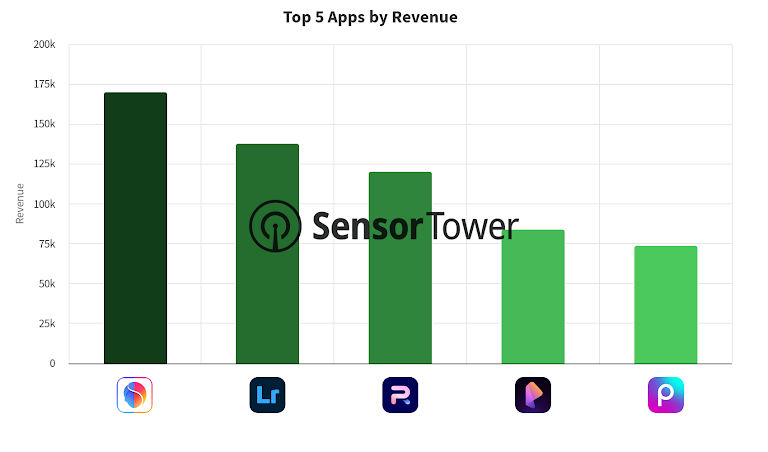
Recent market data from Q4 2025 highlights exactly how concentrated this competition is. The top photography apps in France maintain massive, entrenched user bases. For example, Adobe Lightroom consistently exceeded 622,000 active users in the French market by the end of the year, while apps like Picsart pushed past 770,000 active users. These market leaders secure consistent, high weekly revenue and control the dominant search keywords.
In practice, this creates a specific competitive dynamic. The top positions for high-frequency photography keywords like “retouche photo” (photo editing) or “filtre photo” (photo filter) belong to well-funded global apps with years of ranking history. A newer niche app faces a severe algorithmic barrier. The Google Play ranking system usually evaluates existing keyword authority. Without a large install base to prove relevance, organic keyword rankings stall. This is exactly the situation our client faced.
This plateau is a common growth problem in competitive European markets. An app builds a functional keyword presence, gathers some organic traction, and then stops climbing. The gap between its current install velocity and the install velocity of the top competitors is simply too large to close through basic metadata optimization alone.
The Challenge: Well-Built, But Stuck
Our client’s app had a clear position in the Photo & Video category. It was an analog film filter product designed for users who wanted a retro aesthetic instead of complex editing tools. Six months after launch, the storefront presence accurately reflected this positioning. The metadata was clean, and the semantic core was coherent.
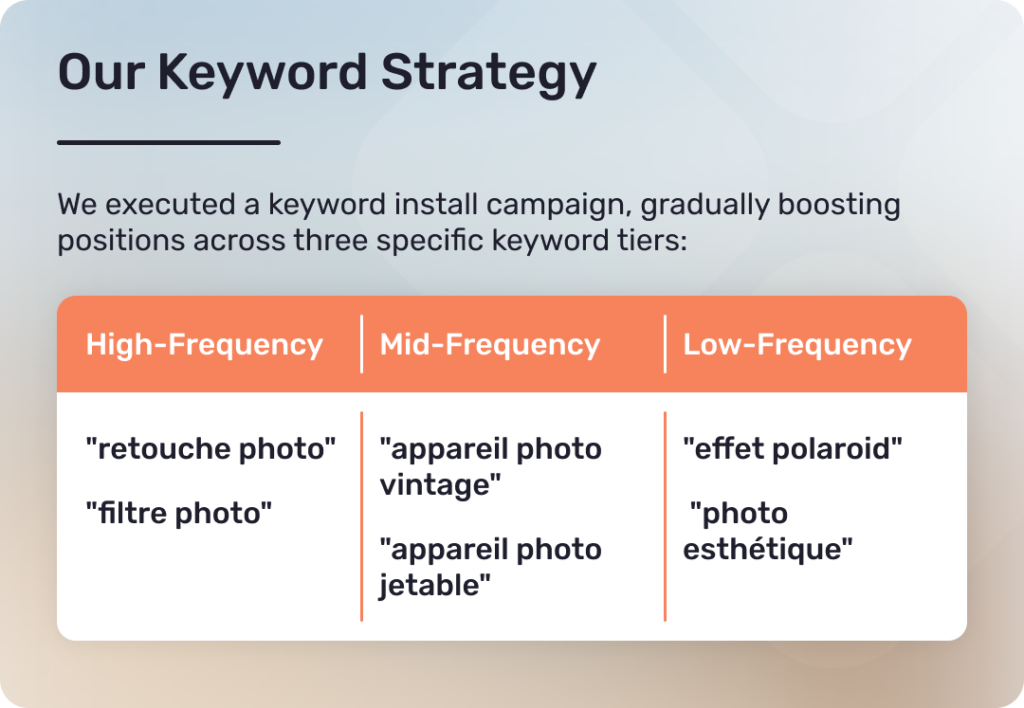
However, the keyword position data told a different story. The app sat at position 54 for “retouche photo” and position 59 for “filtre photo”. For mid-tier keywords like “appareil photo vintage” and “appareil photo jetable,” it hovered in the low twenties. For lower-volume tail keywords like “effet polaroid” and “photo esthétique,” it ranked between 21 and 25.
None of these positions drove actual search traffic. In the Photo & Video category, an app must enter the top 10 to receive actionable organic impression volume. Sitting at position 54 for a high-traffic keyword means near-zero visibility. The challenge was not rebuilding the semantic foundation. The foundation was already solid. The goal was to provide the algorithmic signal required to actually move up the ranks.
Campaigns Structure: A Tiered Keyword Approach
We designed the campaign around a fundamental rule of keyword promotion. You do not start at the top. Attempting to drive installs directly for the highest-competition keywords is inefficient. This approach burns volume against established competitors where the ranking gap is widest. It also fails to give the algorithm a foundation to see the app growing across related search keywords.
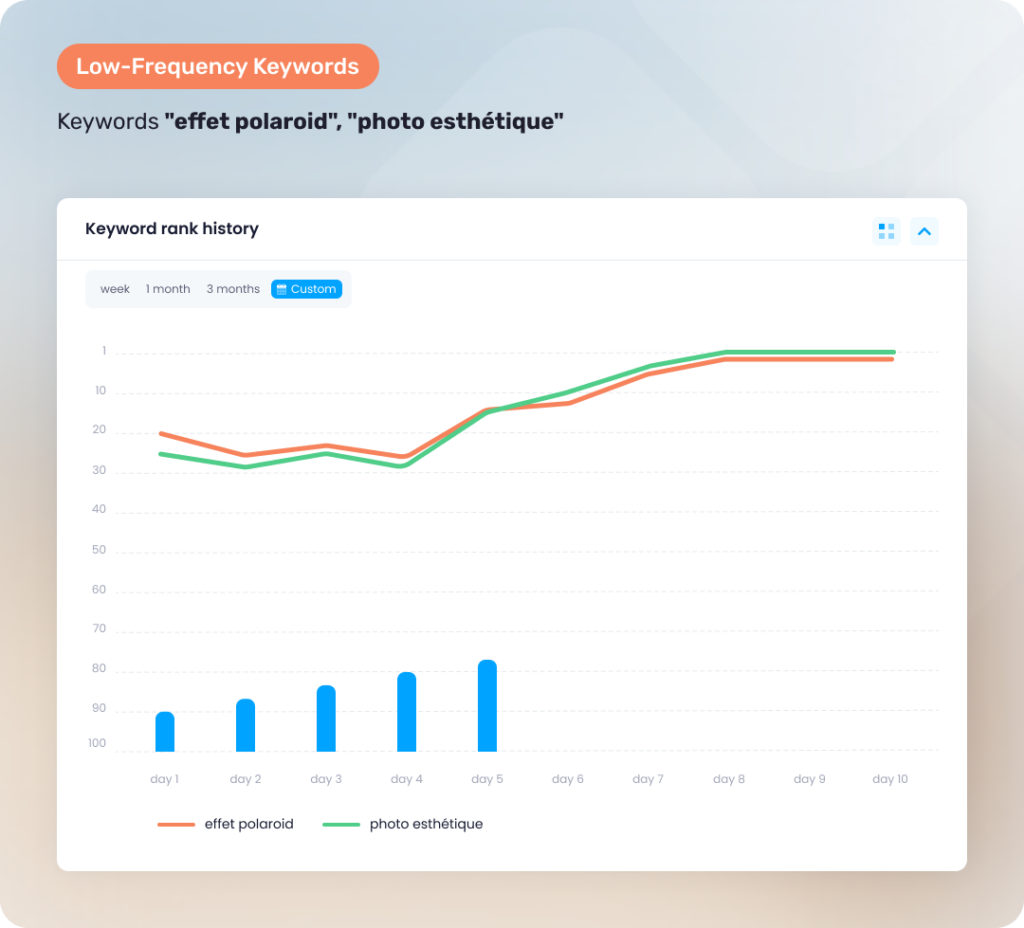
The entry point focused on low-scoring tail keywords like “effet polaroid” and “photo esthétique”. These keywords required the least install volume to move. They served a specific strategic function by establishing contextual authority in the app’s aesthetic niche. Ranking first or second for “photo esthétique” sends Google Play a clear signal about the product type and its target audience.
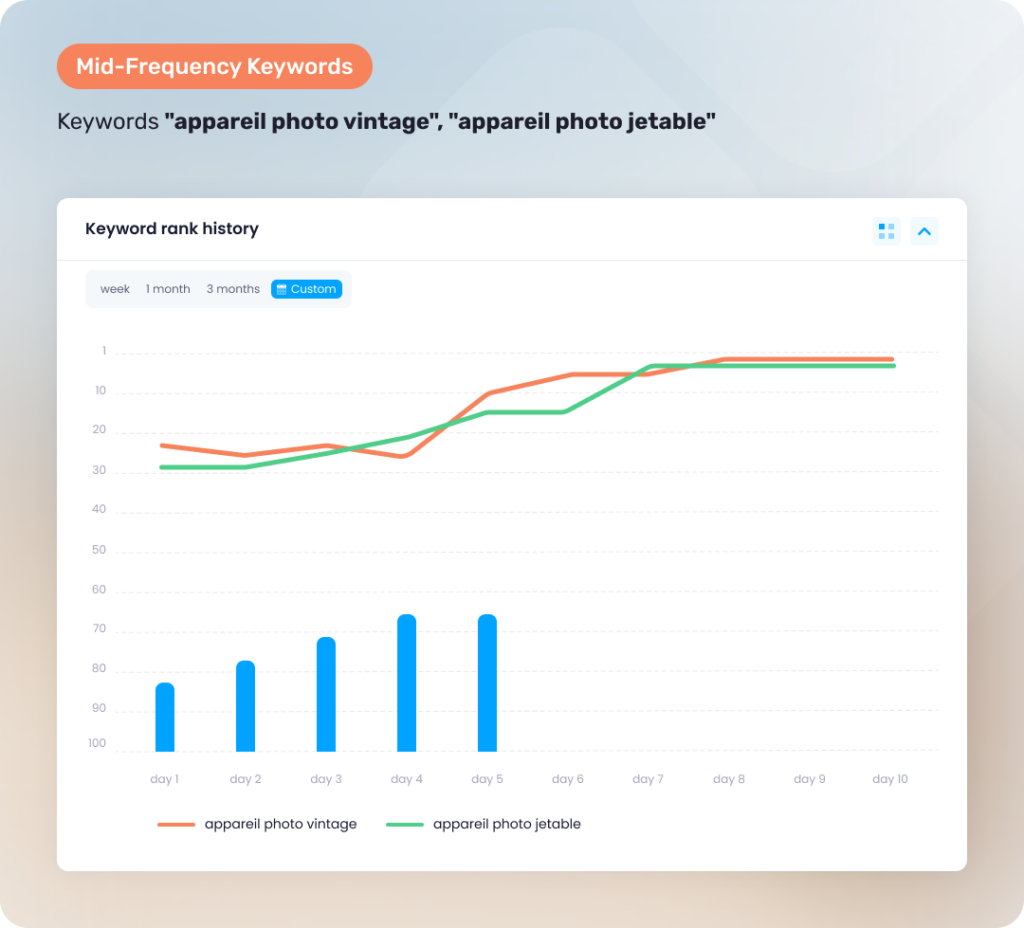
Next, the campaign moved to mid-tier keywords like “appareil photo vintage” and “appareil photo jetable”. These keywords describe specific product types that directly match the app’s core filters. Ranking for them required more volume than the tail keywords. However, the groundwork laid by the lower-tier targeting made the algorithm much more receptive to the new data.
The final phase targeted the high-volume competitive keywords “retouche photo” and “filtre photo”. These keywords drive the majority of Photo & Video search traffic in France. Reaching them after establishing mid and low-tier authority meant the app possessed strong accumulated relevance. This is vastly more effective than starting at the top cold.
Throughout the campaign, we managed install velocity deliberately. Gradual, daily increases in install volume produce a pattern that Google Play interprets as genuine organic growth. Abrupt volume spikes followed by silence generate a negative signal that the algorithm often penalizes. Proper pacing ensures that positions hold after a campaign ends rather than dropping immediately.
Results
By the end of the campaigns, every keyword moved into its target position. The strategic pacing and tiered approach paid off across the board.
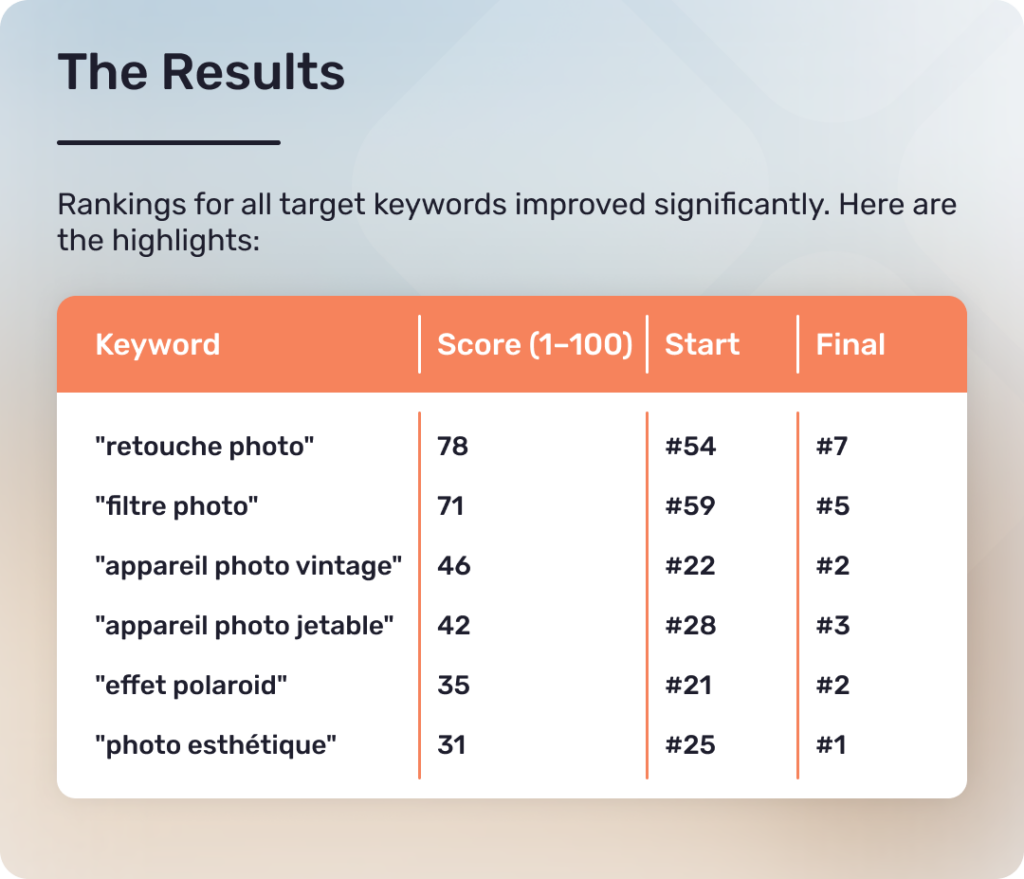
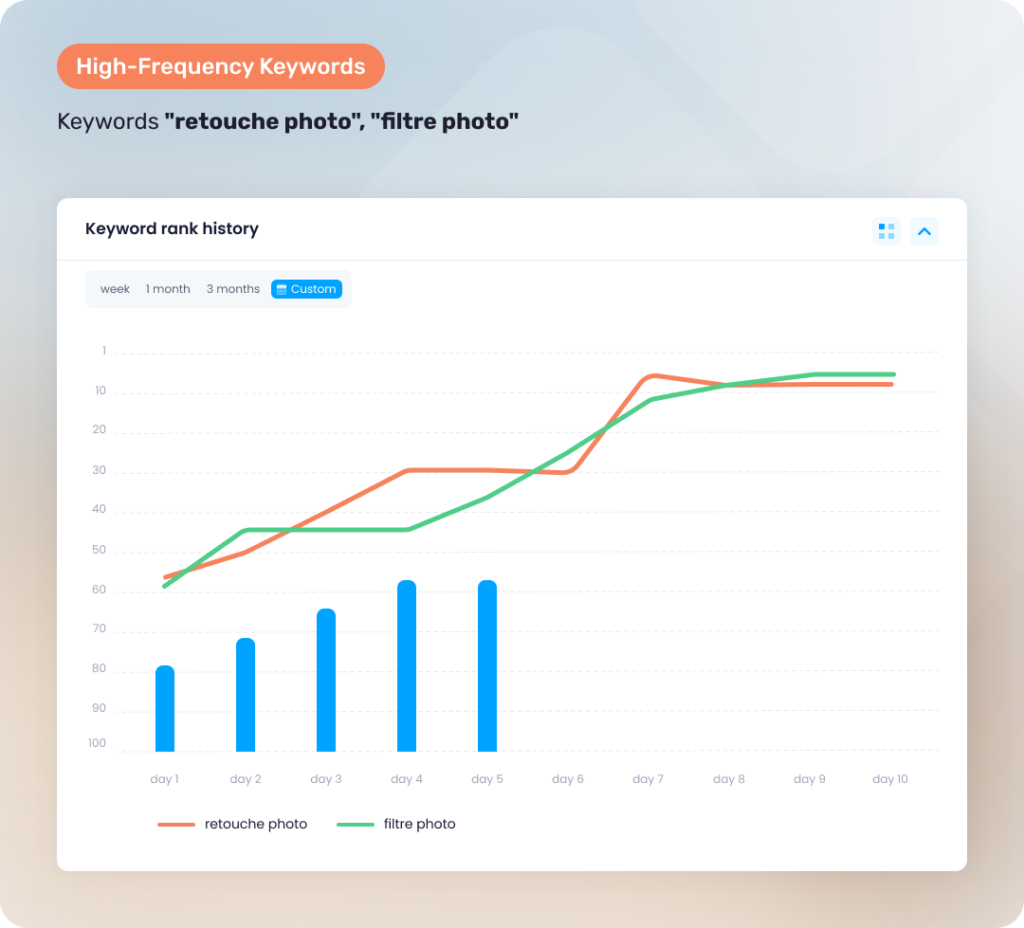
The high-competition keywords “retouche photo” and “filtre photo” jumped from invisible positions at 54 and 59 to rank 7 and 5. This placed them in a range where they generate actual impression volume.
The mid-tier keywords “appareil photo vintage” and “appareil photo jetable” both secured top 3 entries, moving to rank 2 and 3. These jumps proved that the foundational work on lower-volume keywords was successful.
The low-tier niche keywords “effet polaroid” and “photo esthétique” reached rank 2 and rank 1. These positions provide strong organic anchor points for the app’s specific niche within the broader category.
Conclusions and Practical Takeaways
Several observations from this campaign apply directly to keyword promotion in competitive European storefronts. The data shows clear patterns for anyone trying to scale an app in these regions.
- Mid-tail keywords establish categorical authority before you can win competitive keywords. The app reached rank 7 on the highly competitive keyword “retouche photo” largely because it already held top positions on semantically related keywords like “appareil photo vintage”. This dominance built a relevance profile the algorithm referenced when evaluating broader searches.
- Niche-first targeting reduces the effective cost of competitive promotion. An app that enters a competitive keyword campaign with a low relevance signal requires significantly more volume to move. Targeting the lower tier first is an efficiency decision. It makes the later, more expensive phases of the campaign perform better.
- Gradual install velocity produces durable positions. The ranks achieved in this campaign did not collapse after the promotion ended. This outcome ties directly to the pacing model. App store search relies heavily on intent understanding. A velocity curve that mirrors natural organic growth provides a convincing signal to the algorithm.
To sum up, a well-defined semantic core is a prerequisite, not a substitute. This campaign succeeded because the underlying metadata was already coherent. Keyword installs provide the volume signal, but the metadata gives the algorithm something meaningful to match that signal against. Both elements are necessary.
If your app has hit a similar plateau, with good metadata but stagnant keyword positions, the Keyapp.top team can help. We review your current keyword positions, assess your specific category competition, and build a promotion plan that matches your exact mobile growth objectives.
Get in touch with our support team to discuss your campaign!