
Apple’s Keynote, Google Play’s Discovery and Third-Party Stores
- Overview:
- What the September 9 keynote actually changes for app marketers
- Apple widens the canvas for creative assets
- Europe’s App Store dispute finally closes
- Third-party stores get a real foothold on Android
- Google Play’s short descriptions are becoming a discovery signal
- Google Play’s AI driven discovery keeps expanding
- To sum up
The last few weeks turned out to be some of the busiest of the year, not because any single announcement was loud on its own, but because so many of them touched the same nerve: how apps get found. Europe closed its long dispute with Apple over commission rates. A rival Android store returned to Google Play in the US. Apple opened new creative real estate across its store and then, at its September 9 keynote, previewed a version of iOS where Siri, not a search box, decides which app answers a request. Google Play kept refining its own discovery surfaces in parallel. None of it replaces the fundamentals of app store optimization, but together it reshapes what those fundamentals now include.
What the September 9 keynote actually changes for app marketers
Apple’s “Surprise and Shine” event introduced the iPhone 18 Pro line and a first foldable, the iPhone Duo, alongside new Watch and AirPods models. The hardware matters less to ASO than what it forces: a foldable with a genuinely new aspect ratio and a Pro Max chasing a bigger, sharper display both mean product page screenshots and preview videos built for a single form factor will start looking dated fast. Any team refreshing its App Store creative for the fall rollout, the kind of work a tool like Keyapp’s Metadata Generator is built to speed up, should treat these new screen sizes as a checklist item alongside the copy itself.
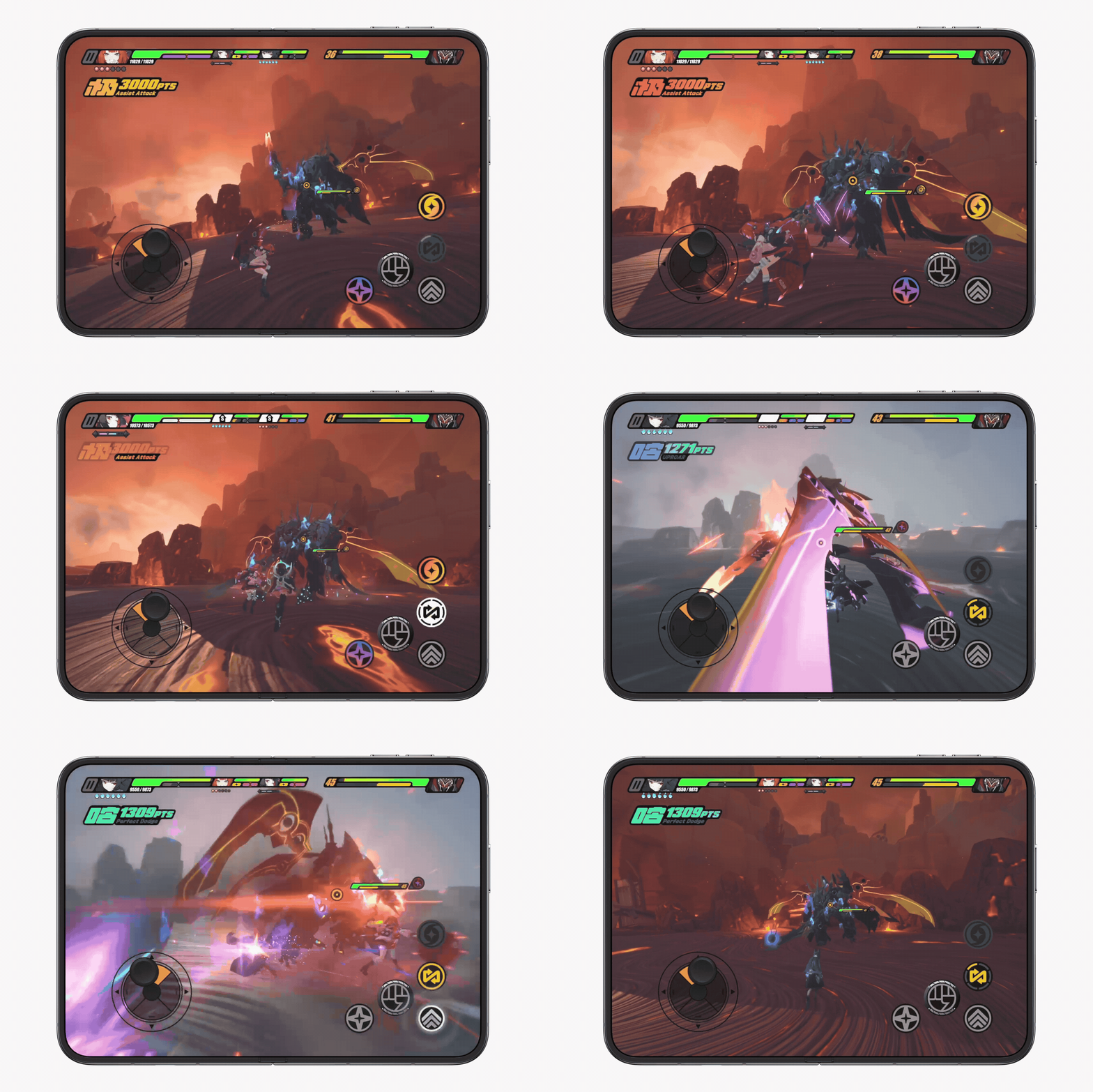
Source
The bigger story sits in software. iOS 27 ships September 14 with Siri AI, a rebuilt assistant that now answers Spotlight searches with generated results instead of a plain list of matching apps. That is a second discovery surface layered on top of the one ASO has optimized for since the App Store opened, and it behaves differently enough that it deserves its own line of thinking rather than a footnote under the new chip.
Apple widens the canvas for creative assets
On August 5, Apple published “Get ready for new creative assets on the App Store,” expanding where creative assets can appear beyond the product page header into search results and In-App Events, and inviting brand identity and seasonal content, not just literal in-use screenshots. The refreshed App Store asset best practices page ties this expansion to iOS 27 and iPadOS 27, and Apple shipped matching Figma, Photoshop, and Pixelmator templates so teams can start producing assets ahead of the fall rollout. The practical takeaway: screenshots are becoming less of a functional walkthrough and more of a merchandising surface, right as Apple’s own event gave the industry a fresh round of imagery to work from.

Europe’s App Store dispute finally closes
On August 18, the European Commission confirmed it welcomes Apple’s revised App Store commission structure, ending the dispute that began with a non-compliance decision over Apple’s steering terms back in April 2025. The new tiered rates depend on distribution method: 26 percent for Apple’s own in-app purchase system, dropping to 15 percent for small business and post-year-one subscriptions, 20 percent for alternative payment processors, 15 percent for out-of-app linking, and a 5 percent Core Technology Commission for apps distributed through alternative stores or the web. The Commission says it will monitor implementation, and Apple still faces separate litigation in the US with Epic Games, but for European developers this closes a chapter that has shaped pricing and payment strategy for two years.

Third-party stores get a real foothold on Android
A parallel change played out on Android. On August 10, Aptoide relaunched its games store inside Google Play in the US, the first rival storefront to do so since a June ruling in Epic Games v. Google forced Google to open its infrastructure to competitors through the Play Catalog Access Program, live since June 22. Aptoide brings over 40,000 apps and roughly 25 million monthly active users, previously reachable in the US only through sideloading. For ASO teams this matters less as a direct ranking factor and more as an early signal that install paths outside the primary storefront are becoming a real distribution channel worth tracking, not a niche workaround.

Google Play’s short descriptions are becoming a discovery signal
Two developments, one older and one brand new, point at the same conclusion on Google Play. The older one is anecdotal: short descriptions written entirely in capital letters started showing up on listings this quarter, visible in examples like Level Infinite’s Delta Force, whose short description reads “AAA EXTRACTION SHOOTER.” Nothing in Google Play Console documentation sanctions this, it is simply a tactic some developers are testing because all caps text occupies the same character count but reads denser against the sentence case copy surrounding it in search and category lists.

The newer development gives that observation more weight. Play Store version 53.1, rolled out the first week of September, now surfaces a short description highlighting a key feature directly inside the similar apps section of a listing’s detail page, alongside a redesigned navigation bar and a new way to see which devices an app is already installed on. That is Google explicitly using short description text as a discovery aid in a surface outside the search results page itself. Whether the copy is capitalized or not, the short description just became relevant in a second place a user’s eye lands, which raises the stakes on getting it right considerably higher than a single line under the app icon ever implied.
Google Play’s AI driven discovery keeps expanding
Google has also been leaning further into AI powered discovery on both ends of the funnel. Ask Play highlights, the AI recommendation block Google introduced at I/O 2026 and now surfaces above standard search results, responds to phrasing rather than exact keywords: rewording one keyword produced a completely different set of recommended apps in independent testing, drawn primarily from the long description and AI summarized reviews rather than star ratings. Separately, Play Store version 52.9, released August 24, introduced App Bundles, curated groups of complementary apps surfaced right after an install, arguably the highest intent moment in the entire store, with Google not disclosing how that curation works. Between Ask Play, App Bundles, and the new similar apps treatment in version 53.1, what happens after a search on Google Play is now doing as much discovery work as the results page itself.

To sum up
None of this needed a keynote to matter. Google quietly started enforcing its Android 16, API level 36, target requirement on August 31, and any app still built against an older target can no longer publish an update and begins fading from view on newer devices, even though installs already on a phone keep working exactly as before. Apple closed a smaller loop of its own around the same point, adjusting App Store prices in Israel, Indonesia, Morocco, and Congo to reflect new VAT rules and currency movement, effective September 14. Pricing keeps its own calendar no matter what else is happening on stage.
Add it up and the five weeks before the keynote never handed the industry one big story to repeat, they handed it the same small one, told several different ways: an assistant that now reads declared capabilities instead of keywords, a similar apps panel that reads your short description, a bundle recommendation nobody at Google will explain, a rival storefront finding its way back onto Google Play, a commission structure Europe finally accepted, and a set of screen sizes that already made last month’s screenshots look dated. Discovery on both platforms is spreading across more places than the search box it used to live in, and the next recap will almost certainly find the map has moved again.