How a hybrid strategy secured Top 5 App Store rankings during the back-to-study season
- Overview:
- The season and the problem
- Why two install types, not one
- Our campaigns, day by day
- What actually moved
- Summary
Self-improvement and study apps get a real bump in App Store search interest once the second half of the academic year opens in Australia. It’s the same pattern other regions see around back-to-school, just on a different calendar. That demand rewards apps that already rank well. It quietly punishes apps still sitting past the Top 30 when the window opens.
Keyword promotion is one of the few growth levers that can move a keyword’s position in days. But not every keyword needs the same tactic or the same budget. This case study follows a 7-day hybrid keyword installs campaign for an iOS micro-learning app, run on two competitive keywords and three supporting ones on the App Store in the Australian market.
The season and the problem
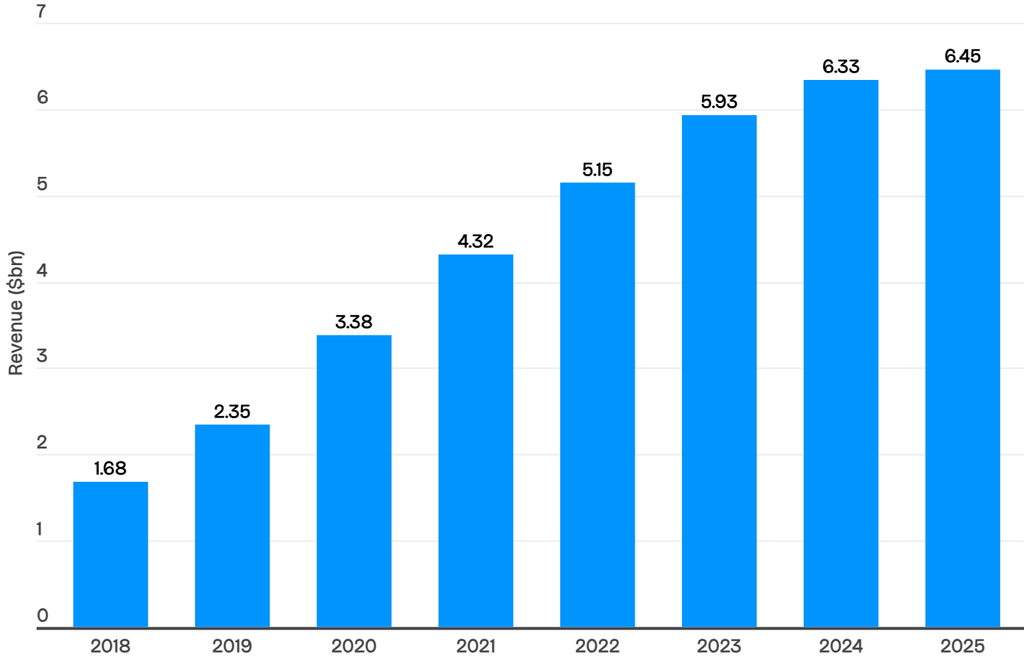
Adult micro-learning is a real, growing category, not a niche experiment. Education apps as a whole pulled in roughly USD 6.4 billion in App Store and Google Play revenue in 2025, up 6.7% on the year before, according to Business of Apps. That growth is exactly why competition for the best keywords in this category keeps getting tighter every season.
Source
The client’s app fits squarely into that category: a bite-sized, anti-brain-rot daily courses app, built around short lessons instead of passive scrolling. It had just shipped its biggest feature release of the year, a spaced-repetition review mode and a bigger course catalog covering focus, study habits, and mental fitness. The release landed right before the return-to-study weeks that open the second half of Australia’s school year, a window when search interest in self-improvement and study tools reliably climbs.
That timing created two problems at once, and they pulled in opposite directions. The app’s two highest-value keywords, self improvement and brain training, sat outside the Top 30. Organic growth alone, driven only by the new feature and normal downloads, would have taken most of the season to close that gap. By the time it did, the highest-search weeks would already be over. Brain training was the harder of the two: it’s an active, well-populated sub-category, with dedicated apps holding years of reviews and loyal users behind them.
Meanwhile, three supporting keywords, study skills, focus timer, and 5 minute lessons, were already bringing in a steady stream of installs. Pulling budget away from them to fund a fast climb on the two competitive keywords risked losing ground there too, right as seasonal demand rose.
Why two install types, not one
Keyword installs move rank because they’re a real signal: a real device completing a real search-and-download flow. But not every keyword needs the same install quality to respond.
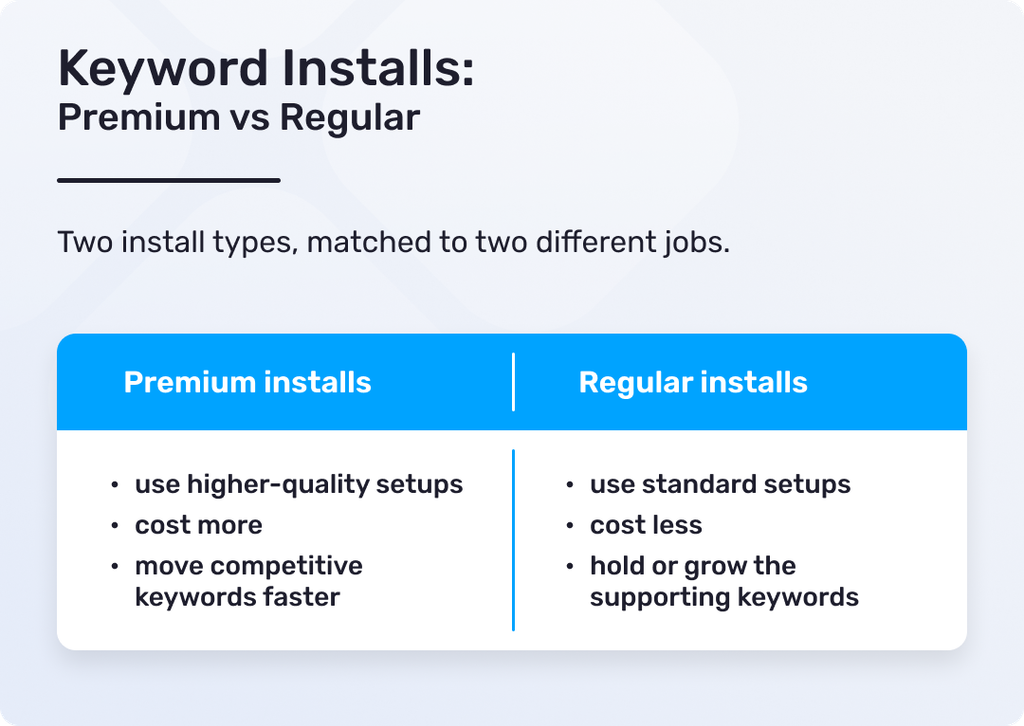
Premium keyword installs went to the two competitive keywords: self improvement and brain training. These run on higher-quality device and account setups: aged, verified accounts, a wide spread of device models, and install behavior that looks like genuine App Store use. That behavior carries more ranking weight. It’s what makes it possible to move a keyword from outside the Top 30 toward the Top 5 in days, not weeks.
Regular keyword installs went to the three supporting keywords. The mechanic is the same: a genuine search-and-install flow. But it runs on standard account and device setups, at a lower cost per install. Each install still adds ranking signal, it just takes more time to move the same distance. Running both install types simultaneously, instead of one after the other, meant the supporting keywords were never left unattended during the days when budget and attention were focused on the Top 5 push.
Our campaigns, day by day
The seven-day window split into five active promotion days and two maintenance days.
Premium keyword installs
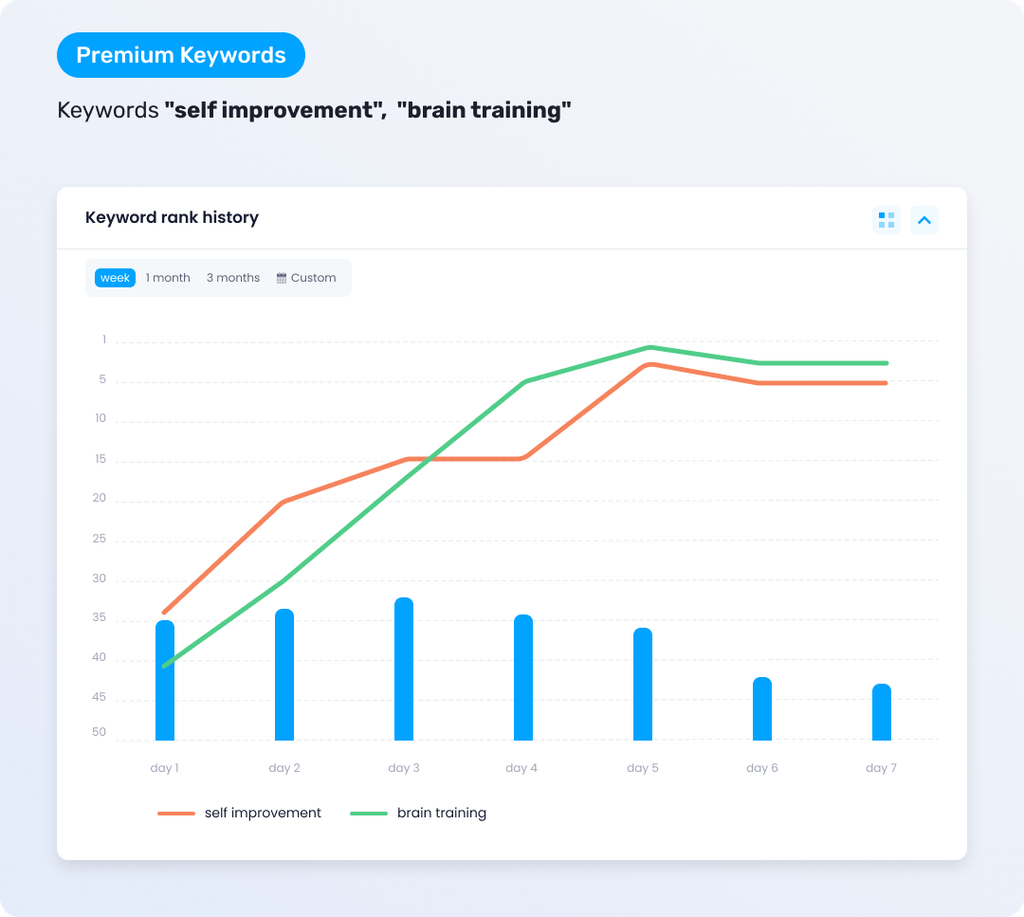
Daily installs on the two Premium keywords started at 210 combined on day one, 110 on self improvement and 100 on brain training. Volume climbed each day and peaked on day three at 290 combined, 150 on self improvement and 140 on brain training, the highest either keyword reached at any point in the campaign. By that point, the early rank movement made clear how much of the target range was reachable inside the timeline and the cap. Volume then tapered down through day five instead of holding flat, since defending a rank near the Top 5 costs less in daily installs than reaching it the first time, dropping to 95 combined installs on day six and 75 on day seven. Across the full week, the two keywords received 1,340 Premium installs between them, without either one crossing the 150-a-day ceiling.
Regular keyword installs
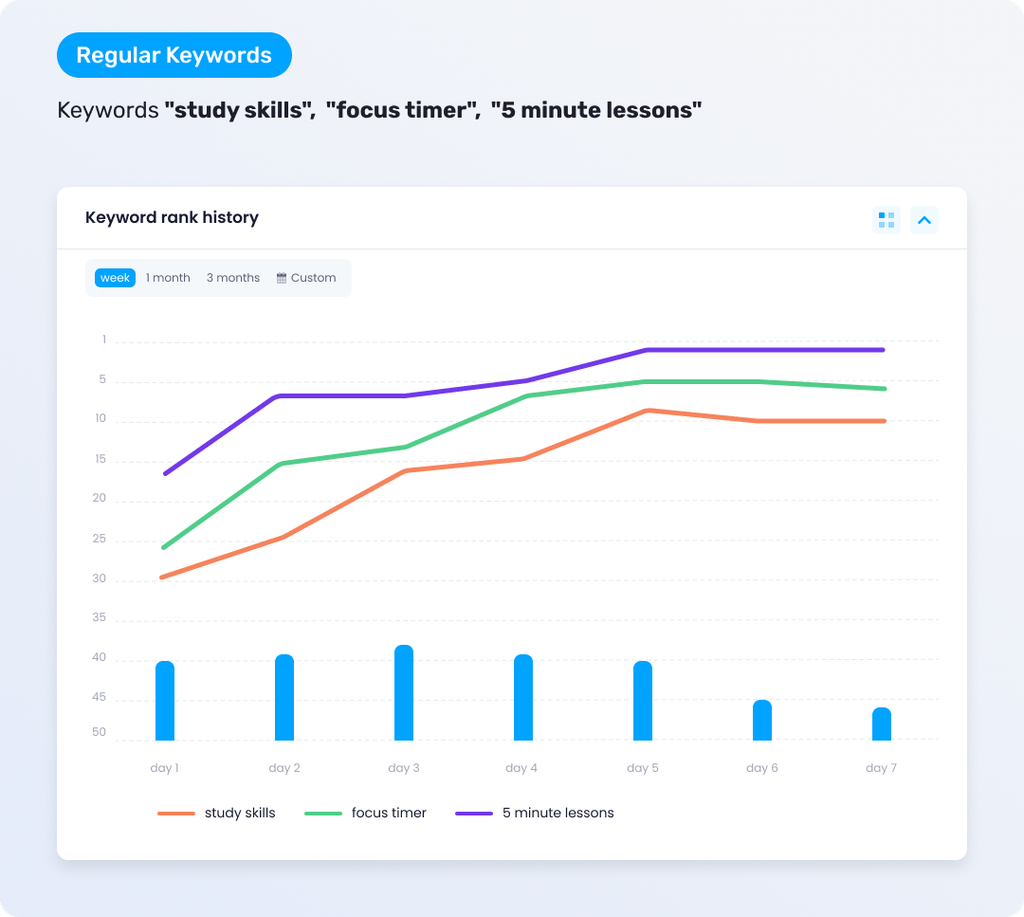
The three supporting keywords ran at a steadier, lower volume across the same seven days, starting at 175 combined installs on day one and rising to a peak of 200 on day three, roughly a third of what the two Premium keywords received on their own peak day. The two maintenance days brought volume down to 95 installs on day six and 85 on day seven, well below peak but still enough to confirm the new positions were holding without paying for growth the campaign no longer needed. In total, the three Regular keywords received 1,100 installs across the week, a lower cost per keyword that matched their lower competitive bar.
What actually moved
All five target keywords improved. Three landed inside the Top 5. Together, the two Premium keywords closed a combined 67 positions of ranking distance, and the three Regular keywords closed another 51, for a total of 118 positions gained across the keyword set in a single week. No keyword fell below its starting rank at any point in the campaign, including during the two maintenance days.
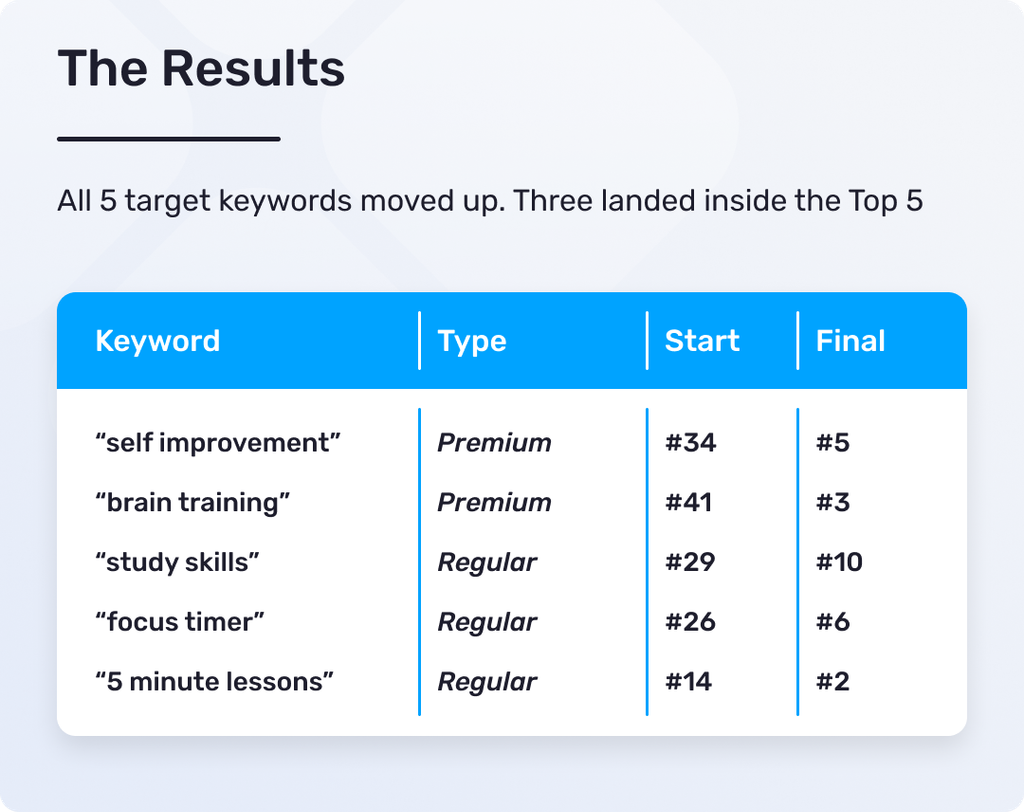
Brain training is the number worth sitting with. It started 7 positions deeper than self improvement and finished 2 positions ahead of it, on the same install quality and almost the same daily cap.
The gap between peak rank and final rank tells a similar story. Self improvement eased two spots from its peak of #3 back to #5 by day seven, and brain training held closer to its own peak, slipping just one spot from #2 to #3. Neither drop reflects a losing position, both keywords simply settled once the tapered, maintenance-level volume replaced the heavier promotion of the first five days.
Summary
The whole seven-day campaign stayed under a 150-installs-a-day ceiling on its hardest keywords, and the smaller size of the Australian App Store, relative to the US or UK, meant that ceiling still carried enough weight to contest keywords sitting outside the Top 30. Matching install type and daily volume to what each keyword’s gap actually requires, and running that mix across a market’s full seasonal window instead of a single push, is the difference between a ranking that holds and one that fades once spend stops.
This is where a platform like Keyapp.top fits naturally. Running Premium and Regular keyword installs in parallel, across the 200+ regions Keyapp supports, gives a team the same flexibility this campaign used on one market: protect the keywords already converting, and put higher-quality installs only where the competition actually calls for them, timed to whichever seasonal peak a given market is heading into. The approach works just as well on a single geo and a modest cap as it does across a global launch calendar, which is what makes it worth building into a standing seasonal plan rather than treating it as a one-off campaign.
If your app has valuable keywords stuck outside the Top 30, the Keyapp.top team can help. We will build a custom promotion plan to meet your exact goals. Contact our support team to discuss your strategy!