A data-backed look at a 14-day combined campaign in the Brazilian sports category.
Getting your app to rank for a competitor’s branded keyword is one of the harder problems in mobile marketing. Users searching for a known brand name are high-intent and often convert well, which makes the keyword valuable but also genuinely difficult to crack. This case study documents how a sports betting app in Brazil eventually reached #1 on a competitor’s branded keyword, not through keyword promotion alone, but through a combined category + keyword approach, and what the data behind that progression actually looks like. It also highlights an interesting regional spillover effect: targeted growth in Brazil triggered organic ranking boosts across other Latin American markets.
The Market Context
Brazil’s sports betting app market is one of the most competitive mobile verticals globally. According to market data, users globally spent 5.3 trillion hours in mobile applications in 2025. In the specific context of this case, Brazil operates as a dominant anchor for the Latin American mobile market, representing nearly 30% of the total global downloads in that sector during the second half of 2025.
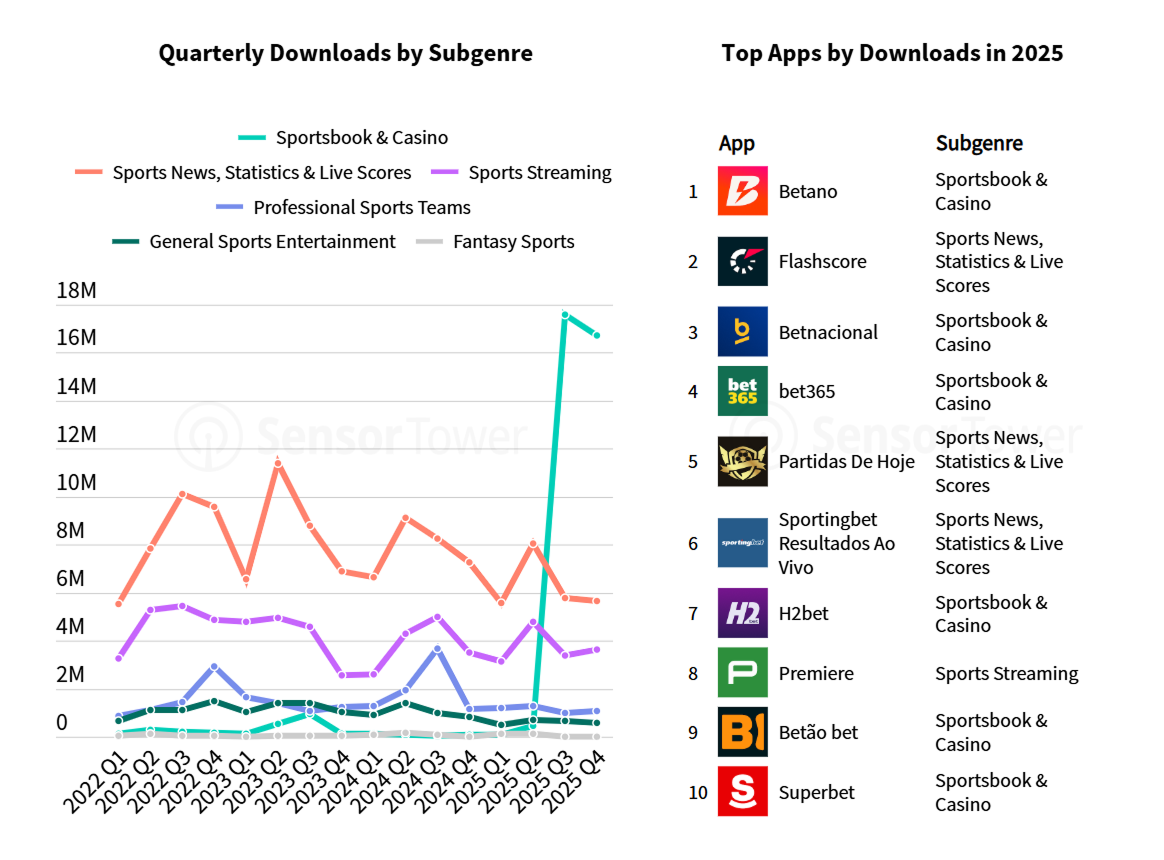
Source
In the Brazilian Google Play market, a vast majority of the top search queries are branded, indicating that users tend to search for specific apps by name rather than using generic keywords. For a competing sports betting app, this dynamic presents both a challenge and a potential opportunity. The challenge is that organic volume for non-branded queries is often quite limited. However, the opportunity lies in the fact that ranking well for a rival’s branded keyword has the potential to redirect a notable portion of that demand.
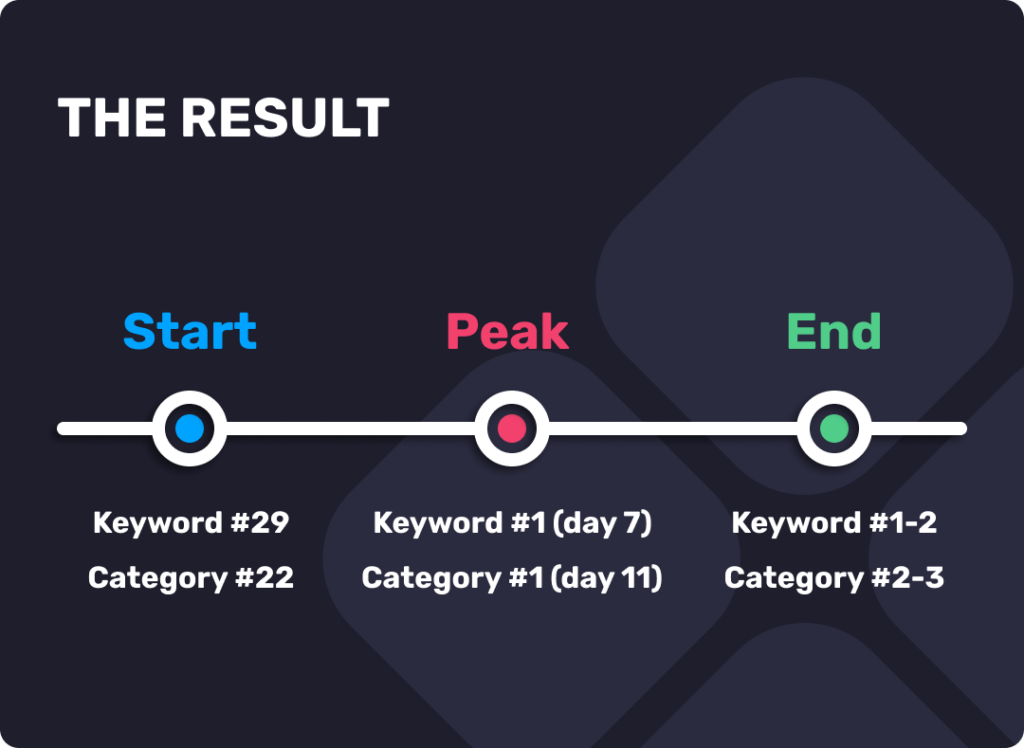
Our client’s app operates in exactly this environment. Before the campaign, it sat at position #29 for the target competitor’s brand keyword, visible to almost no one, generating minimal search-driven installs from that query. A standalone keyword install campaign was attempted to close that gap. It moved the needle, but not far enough and not consistently enough to sustain any meaningful position.
Our Campaign Structure
The campaign ran across 14 days on Google Play in Brazil, targeting the Sports → Top Free category alongside the competitor’s brand keyword (“Betano”). The two tracks ran in parallel: category installs provided the algorithmic authority base, while keyword installs delivered the direct ranking signal for the specific query.
Week 1: Building the Base
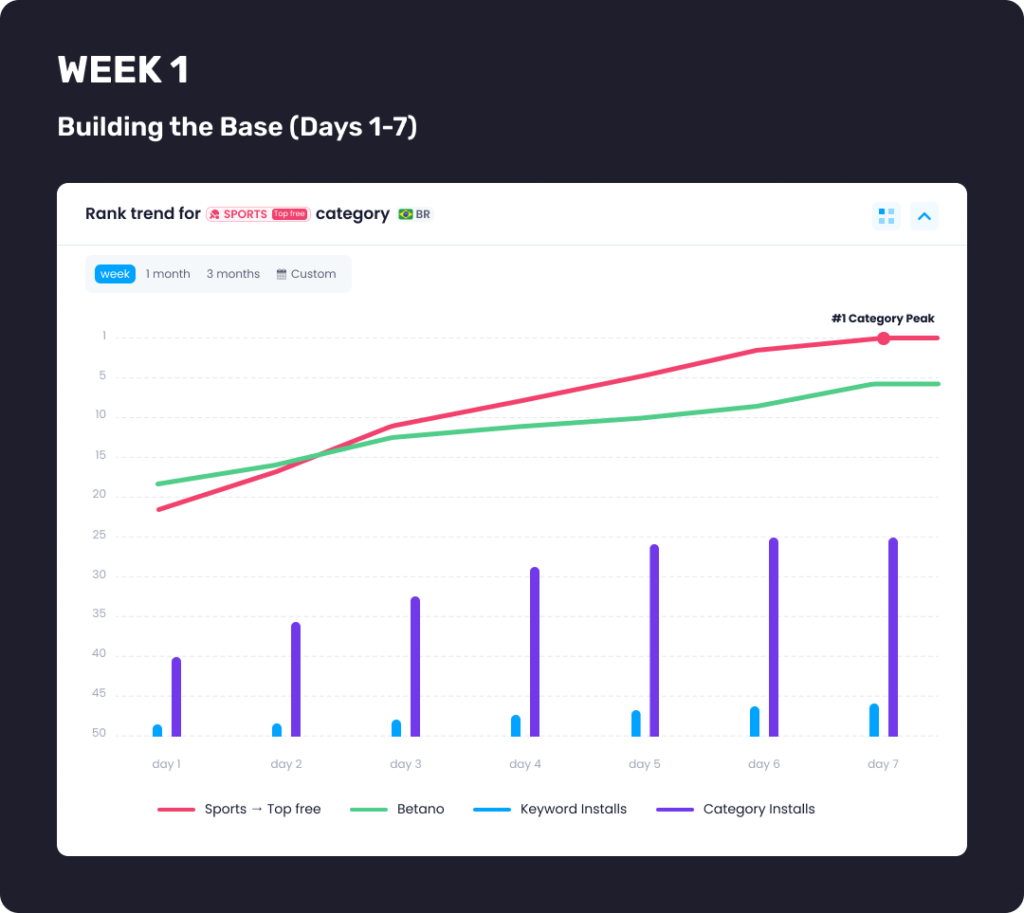
The campaign opened at 2,000 category installs on Day 1, combined with 310 keyword installs. Volumes increased systematically each day — 2,800 / 3,500 / 4,200 / 5,000 — reaching a steady 5,000 daily category installs by Day 5. The keyword volume tracked alongside, scaling from 310 to 690 installs per day over the same period.
The category rank responded quickly: the app moved from approximately position #22 on Day 1 to #5 by Day 5, and reached #2 by Day 6. Simultaneously, the keyword ranking for “Betano” moved from approximately #18 to #6 significantly faster than the earlier standalone keyword campaign had managed over the same timeframe.
Week 2: Hitting and Holding the Top Position
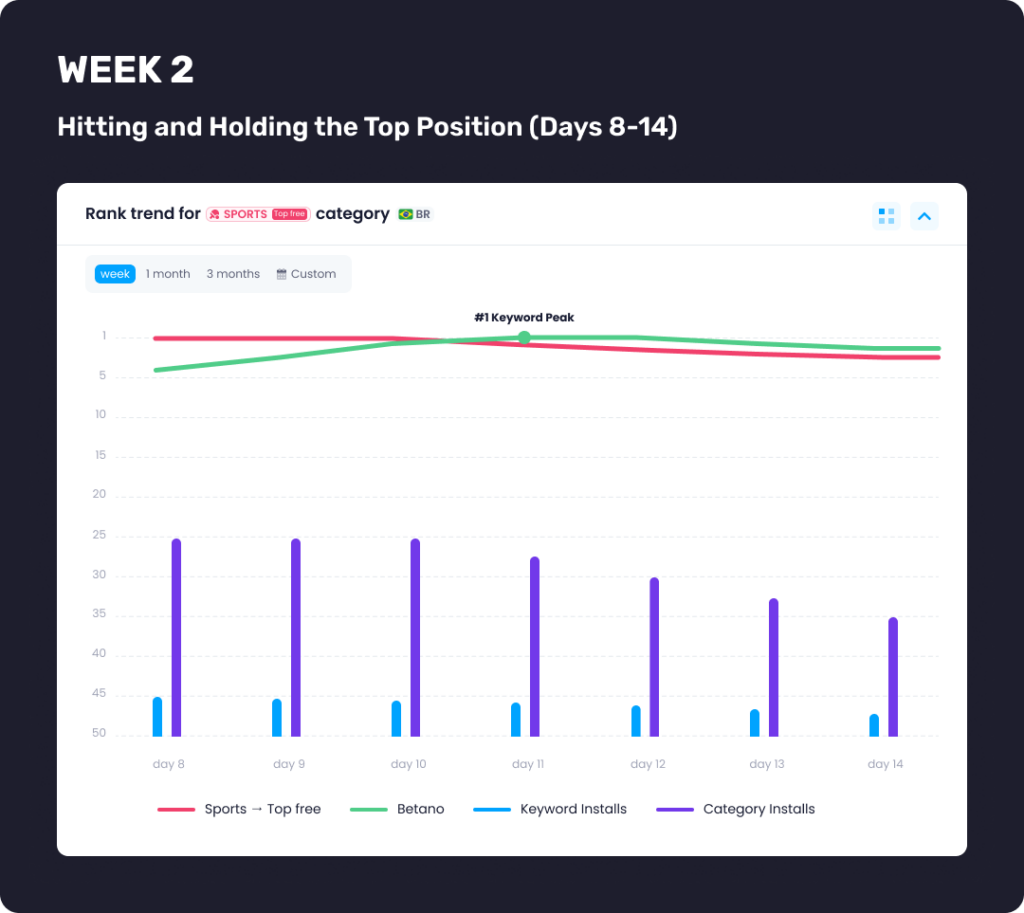
From Day 7 onward, category installs held steady at 5,000 per day. The keyword volume continued climbing 820 on Day 6, 880 on Day 7, crossing 1,000 on Day 8. By Day 7, the category chart hit its peak: #1 in the Brazil Top Free Sports category.
The keyword ranking continued improving in parallel, reaching approximately #4 by Day 8. By Day 11, with category position held at #1–2 and keyword installs at 810, the app reached #1 for the competitor branded keyword.
Rather than stopping abruptly, the campaign entered a gradual wind-down. Category installs stepped down from 4,500 to 3,000, and keyword installs from 720 to 510. The category rank dropped to #2–3, and the keyword position settled at #1–2 by the end of the campaign period.
Results
A few things stand out clearly in the data. First, keyword ranking progress was faster during the combined campaign than it had been during the earlier standalone keyword attempt. In Week 1 of the combined campaign, the app gained more positions than it had in the entire prior keyword-only effort. Second, the keyword peak (#1 on Day 11) came four days after the category peak (#1 on Day 7). This lag is consistent with how Google Play processes signals: category authority builds first, and the keyword ranking effect follows. Third, the algorithmic impact crossed borders. The campaign installs came exclusively from Brazil, but the app’s category rankings simultaneously increased in Argentina and Peru.
What This Means Practically
Several observations from this campaign are worth keeping in mind for similar scenarios.
- Category rank creates headroom for keyword ranking. The app had been stuck around position #22–29 on the target keyword while sitting in the mid-twenties of the category chart. Once the category position moved into the top 3, the keyword ranking became much more responsive to install volume. The data suggests that a category chart position can often act as a ceiling for how high a keyword ranking can climb, especially for high-competition branded keywords where most competing apps are well-funded and actively promoted.
- Branded keywords typically require a larger volume signal compared to generic ones. A user searching for a specific brand like ‘Betano’ generally has strong intent. Because algorithms often associate these queries with established apps, successfully ranking an alternative app for them usually demands a more substantial and sustained install signal than what might be needed for a mid-competition generic keyword.
- Regional spillover effect. The install campaign focused entirely on Brazil, yet the app simultaneously climbed the category charts in Argentina and Peru. When Google Play detects a massive, sustained surge in downloads in one anchor market, the algorithm often interprets it as a regional trend. As a result, the store pushed the app higher in neighboring countries without any direct promotion in those locations.
- The step-down matters. If the install volume had been cut abruptly after Day 11, it is highly likely that both the category and keyword positions would have dropped significantly. The gradual reduction over Days 12–14 allowed both rankings to settle at a level (#2–3 in category, #1–2 on the keyword) that organic traffic can then partially sustain.
Conclusions
Achieving a high ranking for a competitor’s branded keyword is rarely just a metadata challenge. In most cases, standard title or description optimization alone won’t be enough to propel a mid-chart app to the top position for a highly competitive term like ‘Betano. It’s an authority and volume problem. The app needs to signal enough relevance and install velocity to the algorithm for it to consider ranking it against a dominant incumbent.
What this campaign demonstrated is that category and keyword promotion are more effective together than in sequence. For teams operating in competitive branded keyword environments, particularly in markets like Brazil where 100% of top search queries are brand-name driven, this combined approach provides a clearer path to meaningful keyword positions than either tactic running independently. Finally, this cross-border ranking boost proves that a strong category push in a key anchor market like Brazil can act as a catalyst for organic growth across the wider region.
If your app is stuck in a similar position, strong enough to compete but unable to break through on high-value keywords, the Keyapp.top team can review your current category standing, competitive landscape, and keyword targets, and put together a coordinated promotion plan. Get in touch to discuss your next campaign.