
A structured keyword install campaign moved an AI girlfriend app from #142 to Top 20 position in seven days – here’s exactly how we did it.
- Overview:
- The Challenge Is Competing Against Market Leaders
- Our Strategic Approach
- Keyword Promotion Campaign Execution
- Results and Strategic Analysis
- Three Key Insights for AI Relationship App Growth
- Conclusion
The AI relationship category experienced explosive growth through past years as conversational AI technology matured. Major players like Replika established strong positions through extensive user acquisition spending and brand recognition. Therefore, visibility follows a harsh rule: apps ranking outside the Top 10 get minimal organic traffic, while those beyond Top 20 remain almost invisible for potential users.
This case study examines how a client’s AI girlfriend app, facing the typical challenges of this saturated category, achieved measurable keyword ranking improvements just in one week. The results included a #1 position for a conversion-focused long-tail keyword, a #3 ranking for a mid-volume search keyword, and movement from #142 to #18 on the category’s most competitive keyword.
The Challenge Is Competing Against Market Leaders
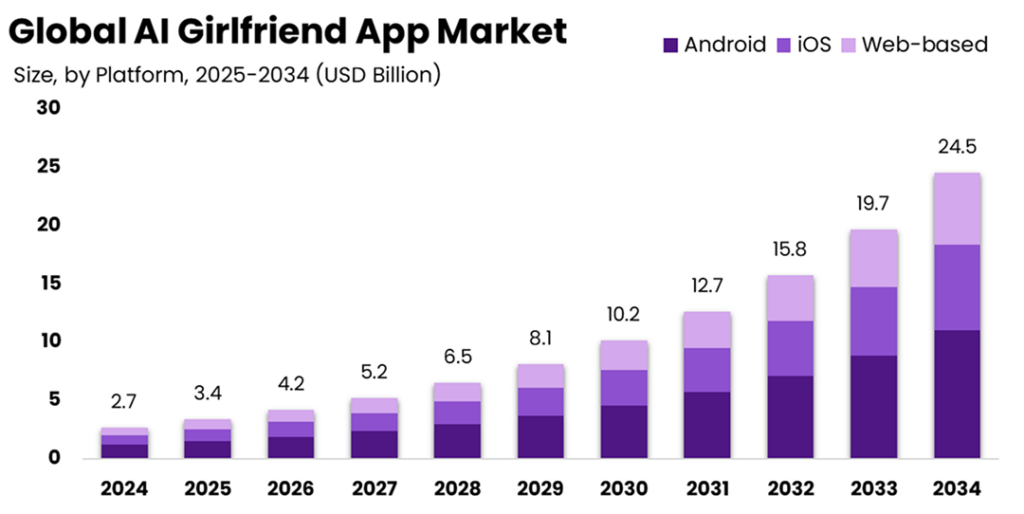
According to research, the AI relationship app market has experienced remarkable expansion, with industry projections indicating growth from $2.7 billion in 2024 to $24.5 billion by 2034 representing a compound annual growth rate of 24.7%. This explosive trajectory reflects genuine user demand: search interest for “AI Girlfriend” platforms surged 525% in a single year, while approximately one in five young adults now express openness to virtual or AI partners.
Source
However, this growth has attracted intense competition. Established players command dominant positions through substantial user acquisition budgets and strong brand recognition. For example, Character AI alone recorded 97 million visits in March 2024, illustrating the concentration of traffic among market leaders. For new entrants, achieving visibility is the critical constraint.
Our client’s app demonstrated solid fundamentals – retention metrics looked promising, user reviews remained positive, but it was effectively invisible. Despite the high revenue potential with 47% of users open to AI relationships and subscription conversions at 17%, the app was stuck at Rank #142 for the core keyword “ai girlfriend”. At that position, sustainable organic revenue was simply out of reach.
Our Strategic Approach
Successful ranking improvements in competitive categories require a structured approach rather than concentrated effort on high-volume keywords alone. We built the campaign around three keywords, each serving a specific purpose.
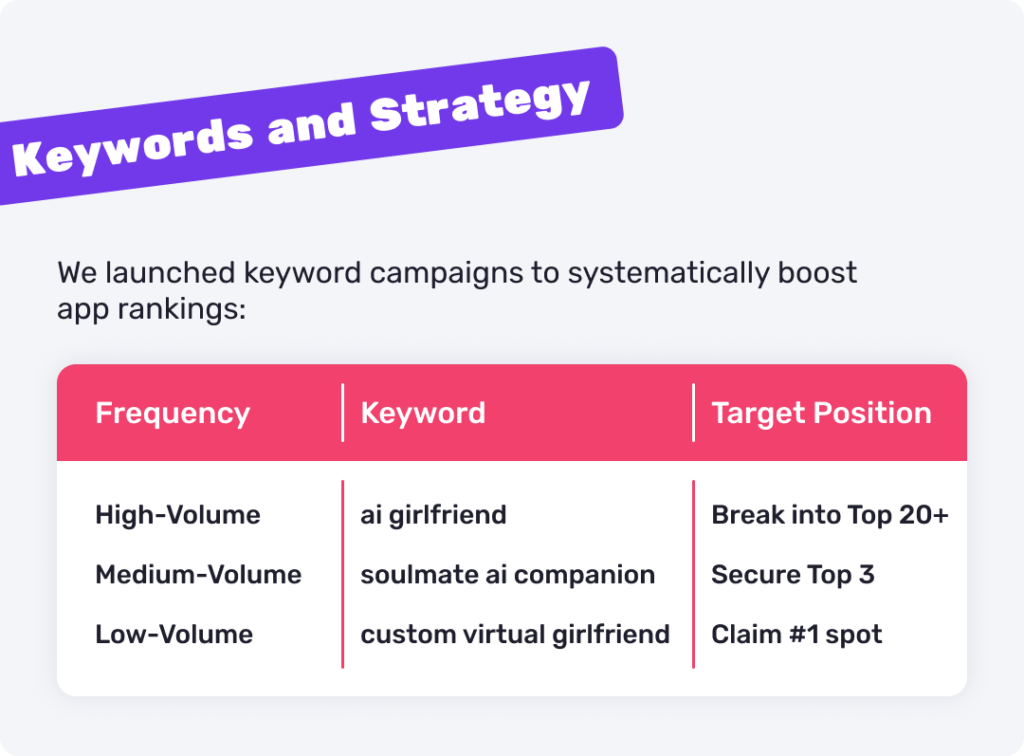
Long-tail keywords convert well because users know exactly what they want. Lower competition made #1 achievable quickly. More importantly, winning here would establish relevance in the virtual companion category, sending trust signals that would help with tougher keywords later.
Mid-volume keywords represent the campaign’s core value. Enough search volume to matter, but not so competitive that we’d need months to break through. A Top 3 ranking here would capture about 40% of searches – real, consistent organic traffic.
High-frequency keywords rarely reach #1 position without sustained effort over months, particularly against established competitors. But we could move from “completely invisible” to “on the board.” Even #18 puts you in the conversation and creates a foundation to keep climbing.
The logic: establish authority on achievable keywords first, then use that credibility to push into competitive territory. Rankings aren’t isolated – they build on each other through what Google calls semantic clustering.
Keyword Promotion Campaign Execution
We ran keyword installs for seven days, scaling volume gradually to look like natural growth.
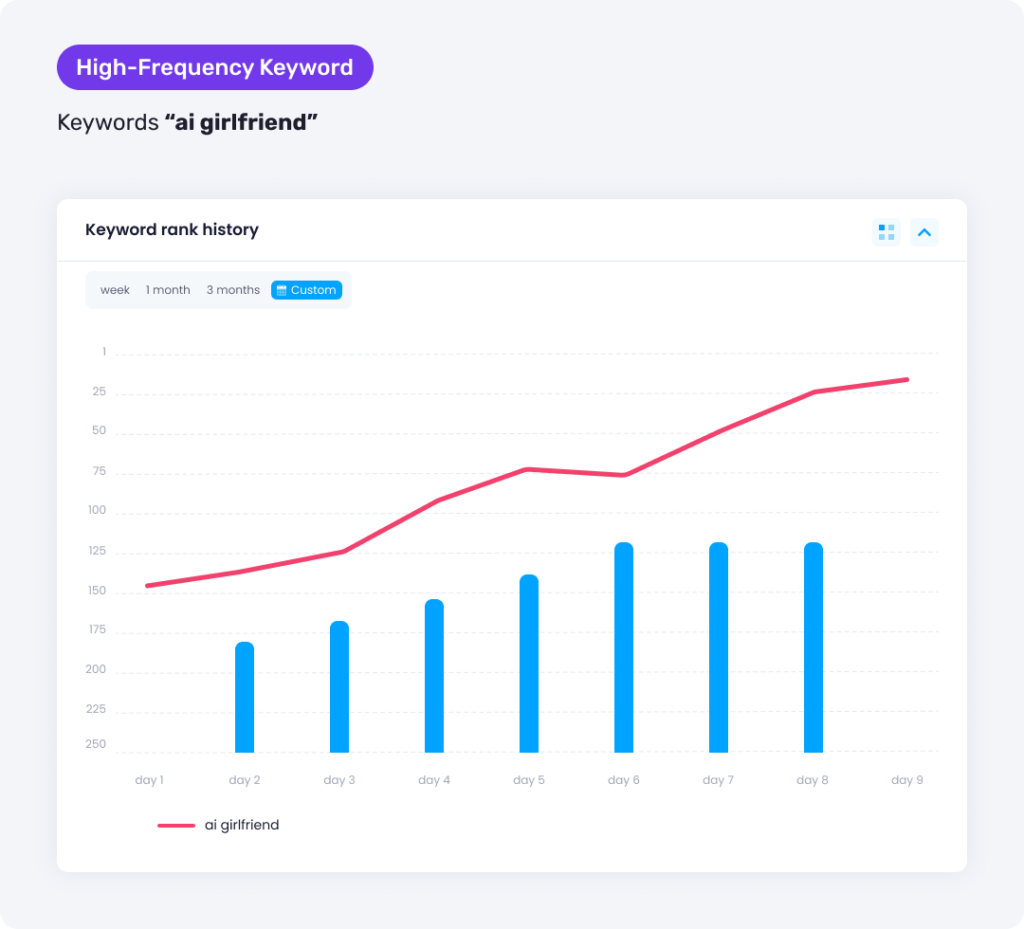
“ai girlfriend”
Starting from position #142, this high-frequency keyword received the most substantial volume throughout the campaign. Day 1 began with 80 installs, establishing baseline signals. Day 2 increased to 120 installs. Days 3 and 4 saw continued acceleration to 140 and 180 installs respectively. Days 5 through 7 maintained a consistent peak of 220 daily installs. This plateau demonstrated sustained user interest rather than a temporary spike – a signal the algorithm values for long-term positioning. The campaign successfully moved the keyword from #142 to #18.
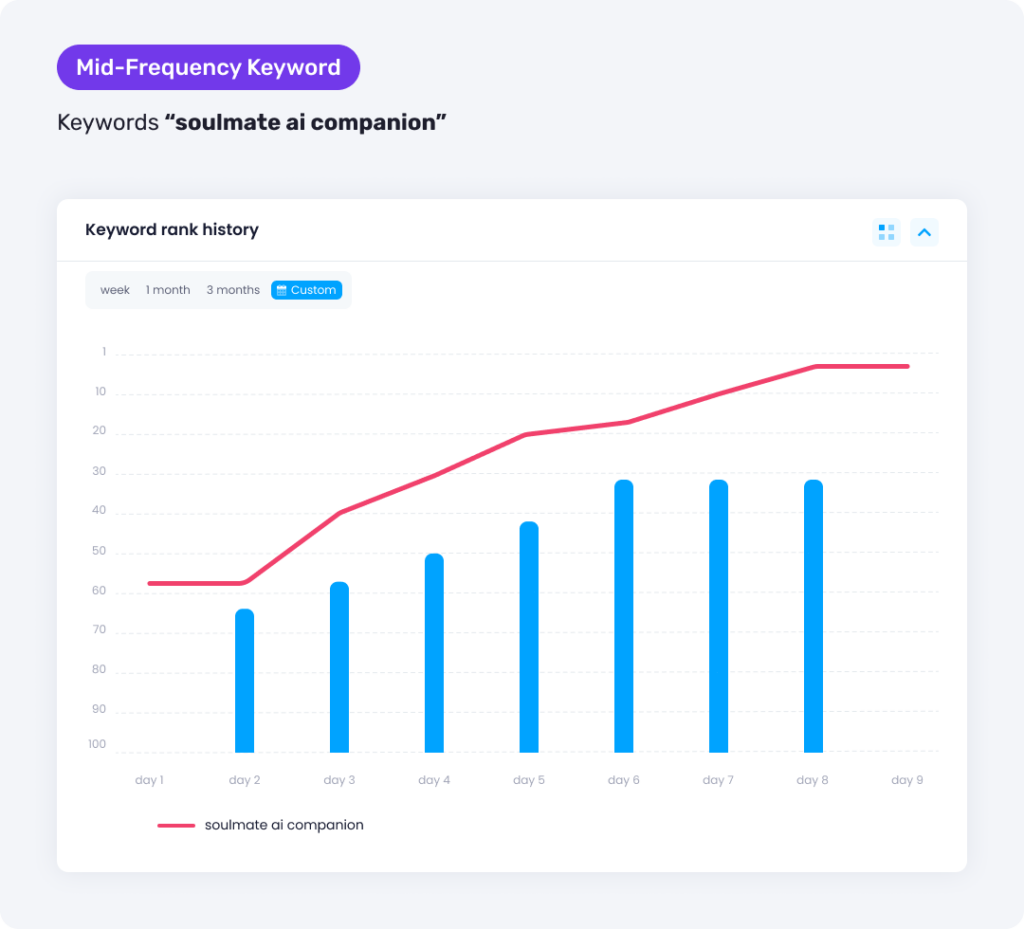
“soulmate ai companion”
This mid-frequency keyword started at position #58. Day 1 delivered 35 installs, followed by 55 on Day 2. Progressive acceleration continued through Days 3 and 4 with 70 and 85 installs. Days 5-7 maintained 90 daily installs. The volume ratios relative to the high-frequency keyword reflected realistic search behavior, users naturally concentrate searches on popular keywords. This structured approach secured a #3 ranking.
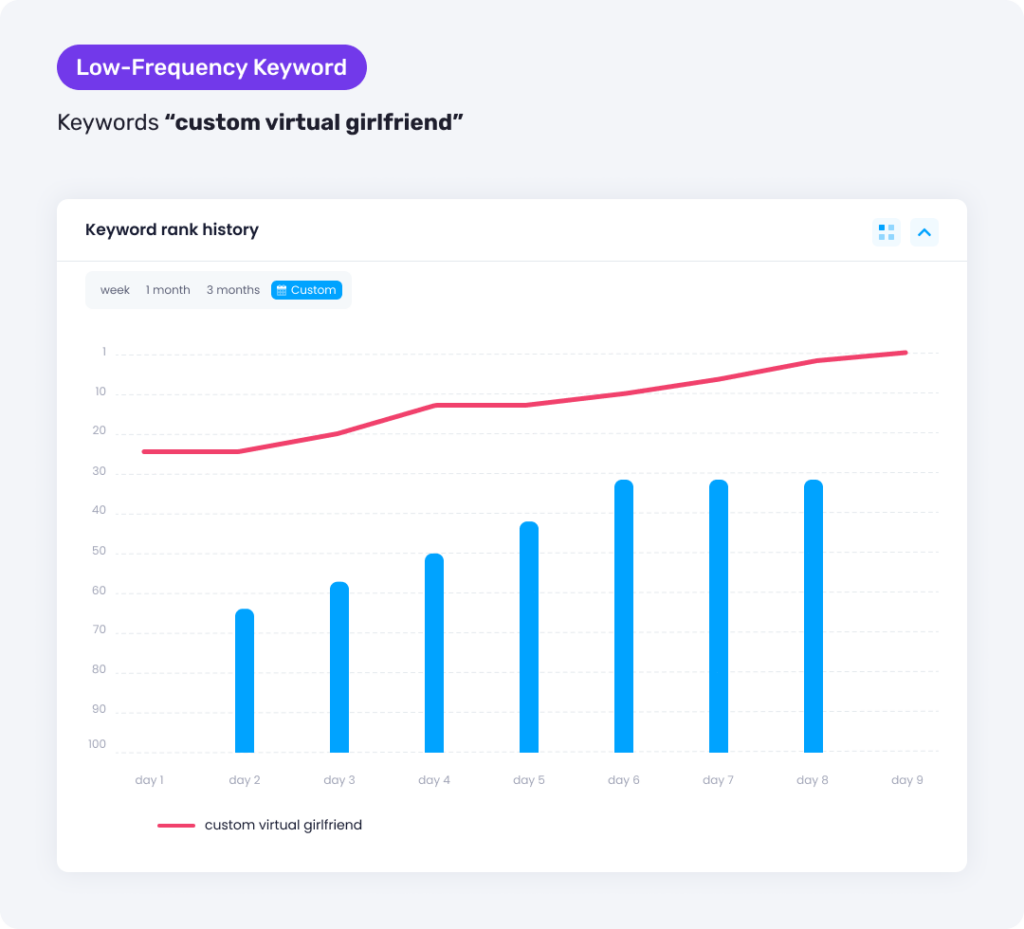
“custom virtual girlfriend”
Beginning at position #24, this low-frequency keyword required more modest volume. The campaign started with 20 installs on Day 1, increased to 35 on Day 2, then progressed through 40 and 55 installs on Days 3 and 4. Days 5-7 maintained 65 daily installs. Despite lower absolute numbers, the strategic concentration achieved a #1 ranking for this conversion-focused keyword.
Results and Strategic Analysis
After seven days, the campaign delivered three distinct outcomes with different implications for the app’s organic growth trajectory.
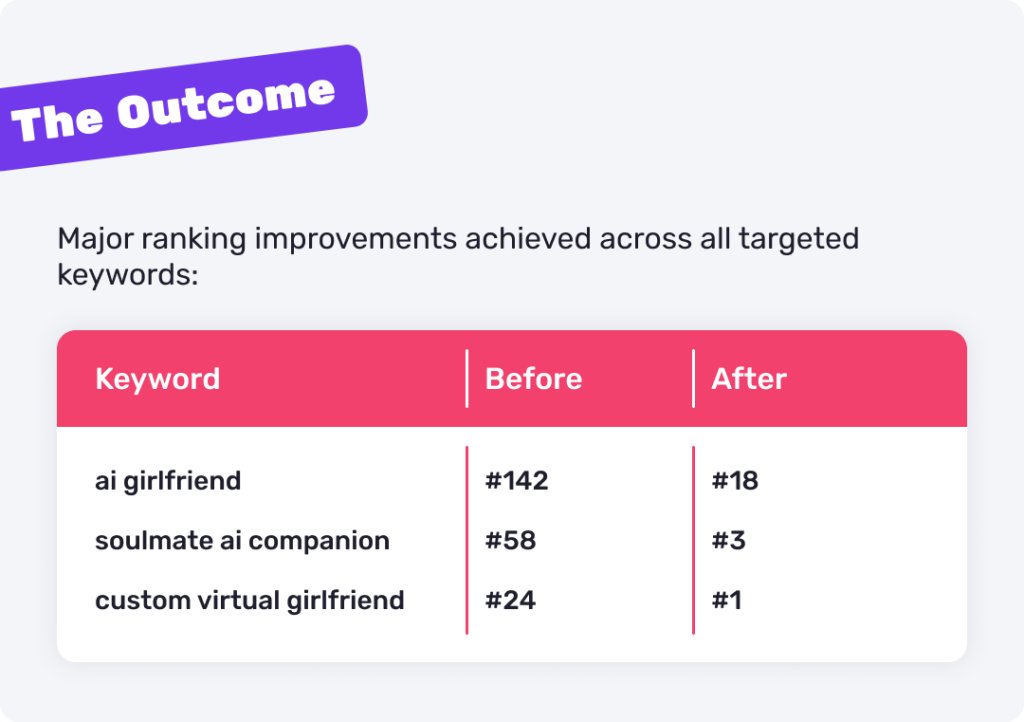
“custom virtual girlfriend” → Rank #1. This ranking won’t flood the app with downloads, but users searching this specific term convert at high rates. They know what they want. And the #1 position established authority. Google’s algorithm now connects this app with virtual companion concepts across related keywords, even ones we didn’t directly promote.
“soulmate ai companion” → Rank #3. Top 3 captures roughly 40% of search traffic for this term. That’s consistent organic installs every month, no ad spend required. In a category where subscription models hit around 17% conversion rates, each organic install can have long-term value. Plus, success here lifted other related terms we didn’t even target. The algorithm recognized broader category relevance.
“ai girlfriend” → Rank #18. This won’t drive much immediate traffic – users rarely scroll past page one. But it accomplished two things. First, it put the app on the map in the category’s most competitive keyword. In a market growing from $2.7 billion to $24.5 billion, establishing relevance for primary category terms matters for long-term positioning. Second, it proved the algorithm accepts the app as relevant here. That’s the foundation for climbing higher. With continued organic performance plus periodic promotional support, Top 10 is achievable over the next few weeks.
Three Key Insights for AI Relationship App Growth
1. Build authority bottom-up, not top-down
You can’t compete with Replika on “ai girlfriend” immediately. Start with achievable long-tail keywords. Win there. Use that credibility to climb. With 54% of users wanting AI help finding matches and the market expanding at 24.7% annually, there’s room to grow strategically rather than fighting established players head-on from day one.
2. Top 20 creates foundation, Top 5 drives results
Breaking into the Top 20 is progress, but it’s not the finish line. Research shows users rarely scroll past page one. Apps at #15-20 get minimal traffic compared to #3-5. Current data shows 67% of users engage daily with AI companions, and 45% form emotional attachments within three weeks, but only apps in top positions capture this engaged user base. Position #18 matters as a starting point, not as an end goal.
3. Scale installs like organic growth, not like a promotion
Start conservative. Build gradually. Hold peak volume instead of spiking higher. Sudden jumps look suspicious. Natural-looking growth patterns keep you under the radar of fraud detection while sending the right signals to ranking algorithms.
Conclusion
The work continues. “ai girlfriend” is still getting promotional support, targeting Top 3 over the next 30-60 days. As that ranking improves, the increased traffic and engagement will strengthen authority across all the mid and long-tail keywords. It compounds.
For developers in competitive categories, this approach offers something paid ads can’t: organic authority that survives when you stop spending. It requires patience and realistic expectations – Top 20 builds foundation, Top 5 drives traffic – but in a category where Character AI hit 97 million visits and nearly half of users are open to AI relationships, the strategic value of organic rankings keeps growing.
Explore effective keyword promotion strategies at Keyapp.top and discover how keyword installs campaigns can build your app’s category authority.