Driving a mobile golf game to the top tier in 21 days through category promotion.
- Overview:
- The Challenge of Promotion in Mobile Gaming Categories
- The Strategy: Keyword Promotion vs. Category Promotion
- Campaign Breakdown: A 21-Day Scaling Plan
- Practical Insights and Conclusions
- Next Steps for Mobile Marketers
Securing top positions in category charts requires a fundamentally different strategy than standard keyword optimization. This case study details how a mobile golf game advanced from Rank #68 to Rank #3 in the highly competitive UK Top Free Sports Games category. By executing a 21-day campaign, the app achieved top-tier visibility and earned the algorithmic “Trending” badge. The data confirms that steady volume beats sudden spikes when maintaining ranking stability.
The Challenge of Promotion in Mobile Gaming Categories
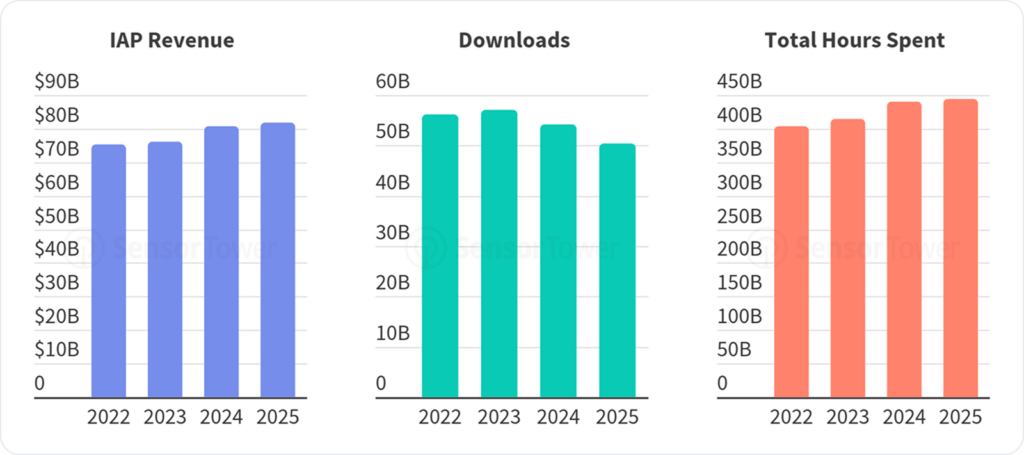
The mobile gaming market is overcrowded and requires a highly targeted user acquisition (UA) strategy. According to Sensor Tower’s 2026 State of Mobile report, users collectively spent 5.3 trillion hours in mobile apps, yet gaming downloads have largely plateaued as the market shifts from volume to UA efficiency. In highly competitive, seasonally driven niches like Sports Games, organic search alone rarely moves the needle.
Source
Category charts are influenced by the performance of many applications simultaneously, rather than just specific keyword competitors. The top positions in the Sports category are frequently occupied by legacy titles from large studios, creating a barrier to entry for independent or mid-sized developers. For our client`s mobile game, starting at Rank #68 in the UK Top Free Sports Games category meant the app was virtually invisible to users browsing the store.
A substantial portion of mobile game discovery happens through the Browse and Explore tabs. In these sections, users browse top charts with no specific app in mind. Without a high category ranking, a mobile game loses access to this critical segment of exploratory traffic, limiting growth to search-driven installs only.
The Strategy: Keyword Promotion vs. Category Promotion
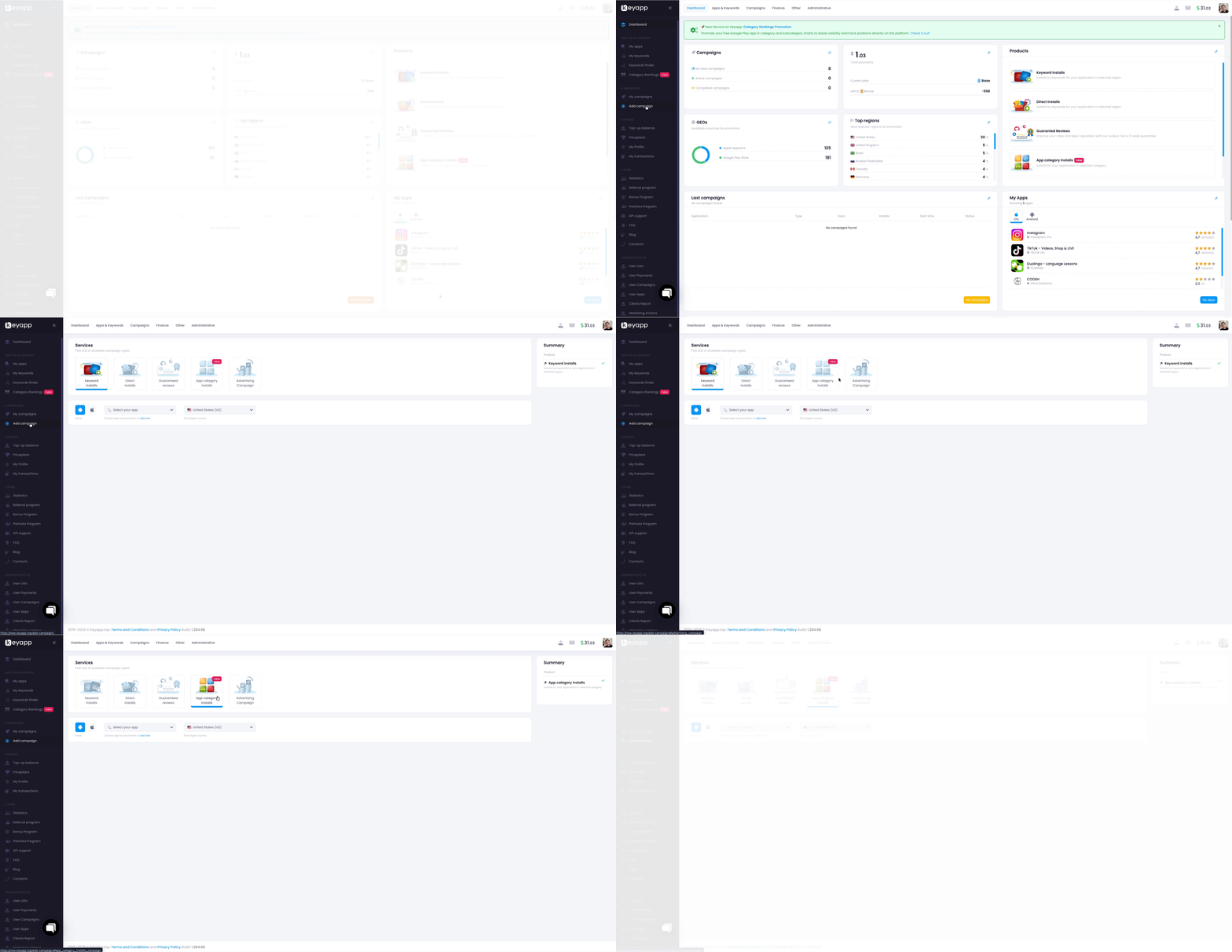
We announced category promotion on our platform relatively recently. Category promotion requires a completely different approach than standard keyword promotion. When executing a keyword campaign, an app competes only against other apps indexed for that specific text query. In contrast, category charts are influenced by many apps simultaneously, meaning the competitive pool is much wider. You are no longer competing just against other golf games; you are competing against football managers, tennis simulators, and racing games for the same limited top positions.
Source
Because of this broad competition, moving positions within a category requires large daily volumes of installs, often starting in the thousands. Furthermore, Google Play category rankings are highly volatile; the algorithms update frequently and react instantly to volume changes.
This volatility defines the basic rule of category promotion: keep volumes stable. A massive influx of traffic on a single day, followed by zero traffic the next, signals artificial manipulation. If you drop install volumes abruptly, the algorithm will instantly penalize the app’s position. Therefore, the Keyapp.top strategy for our client`s mobile game ran a controlled, 21-day ramp to maintain ranking stability.
Campaign Breakdown: A 21-Day Scaling Plan
The campaign ran in three phases to secure a stable top ranking. For a step-by-step walkthrough of category promotion, watch our video guide.
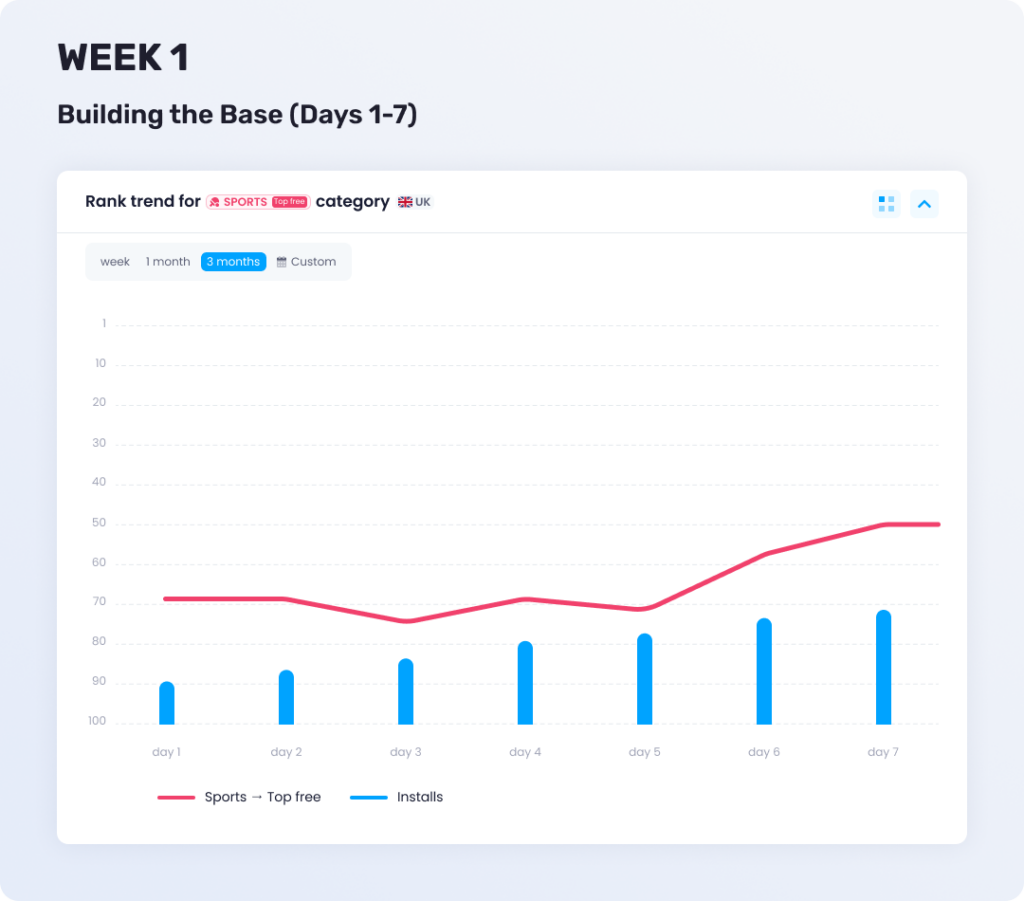
Phase 1: Building the Base (Days 1–7)
The campaign began with a moderate baseline to establish a natural growth pattern. On Day 1, the app received 1,500 installs. Rather than jumping immediately to peak volume, the installs were systematically increased each day. The volume grew to 2,200 on Day 2, reached 4,500 by Day 4, and closed the first week at 8,200 installs on Day 7. This day-over-day sets a secure foundation for the scaling phase. It signals to the store that the app is gaining genuine, compounding traction.
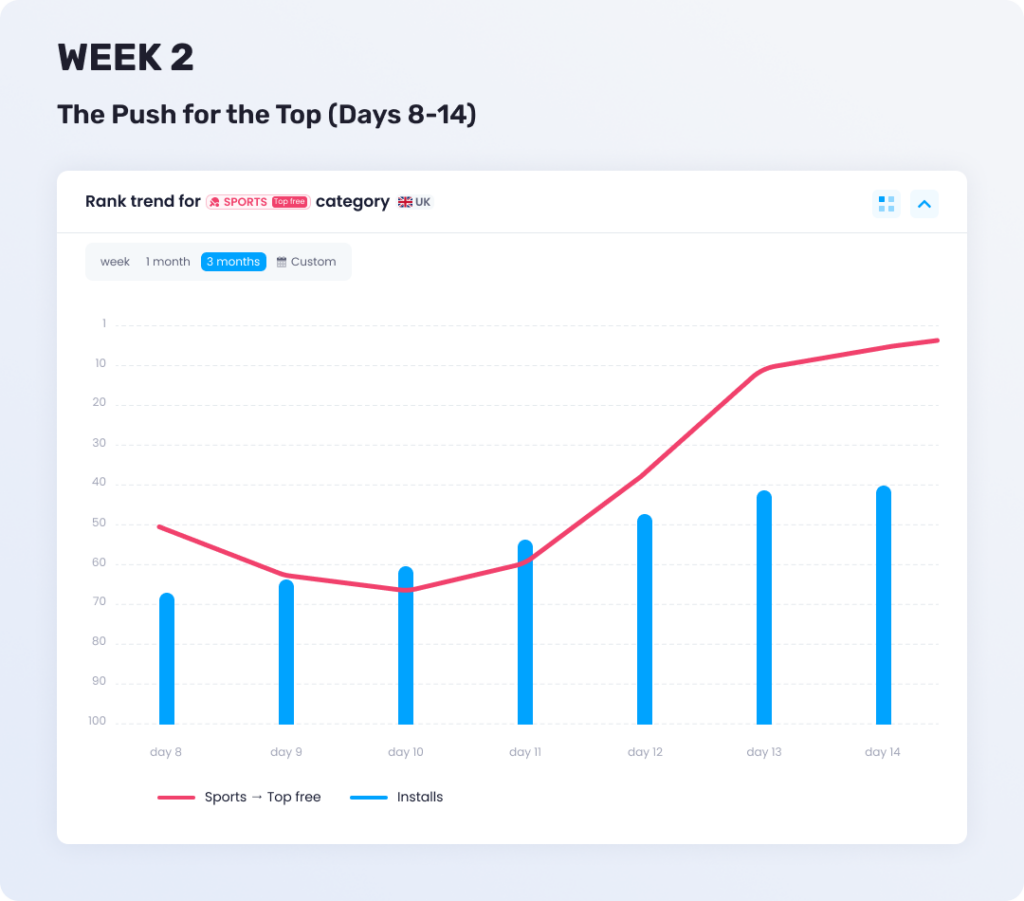
Phase 2: The Push for the Top (Days 8–14)
Then, the daily install volume was scaled to secure top-tier visibility against heavy category competition. The campaign delivered 9,000 installs on Day 8, pushing past the 10,000 mark by Day 10. The volume peaked at 11,500 daily installs from Day 12 through Day 14. Sustaining this peak volume for consecutive days pushed the app high enough for the algorithm to rank it as a top performer. By Day 14, the app hit its peak at Rank #3. At this stage, the sustained growth earned the app the ‘Trending’ badge.
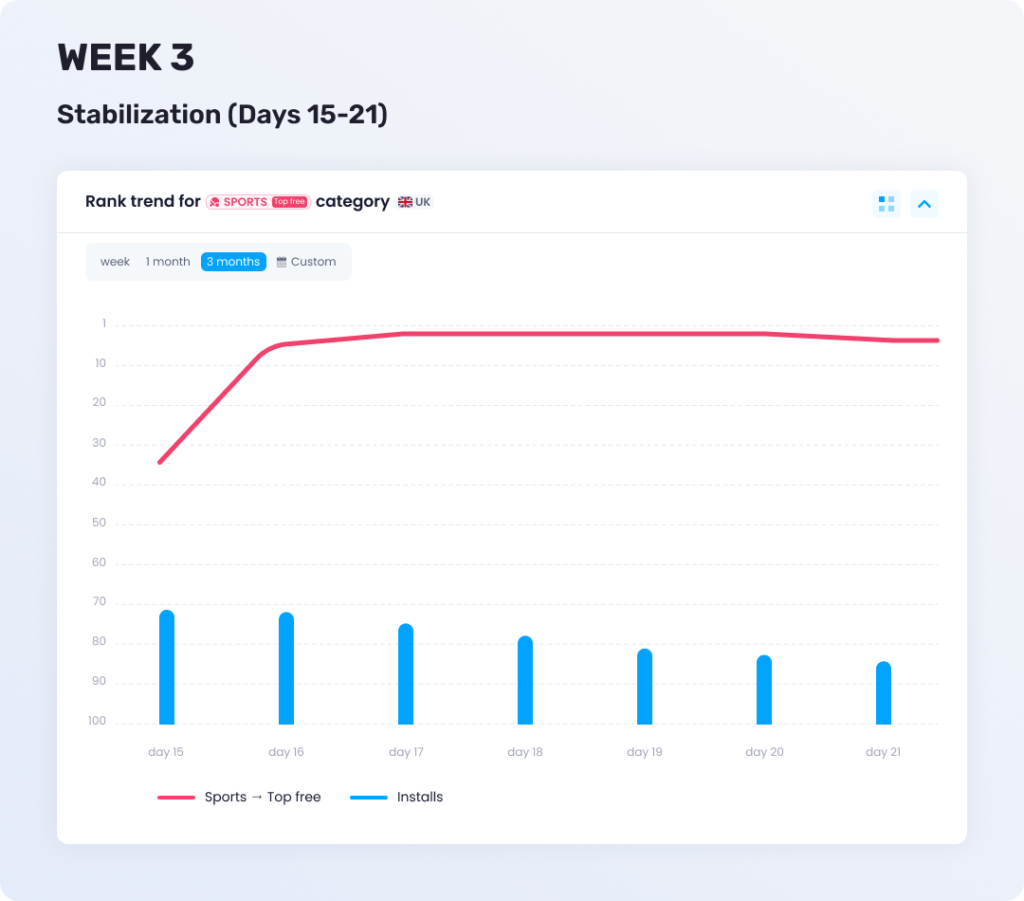
Phase 3: Stabilization (Days 15–21)
A sudden halt in promotional traffic after reaching the peak would have collapsed the newly acquired rankings. The stabilization phase is often skipped and that’s where most campaigns lose their gains. To prevent a crash, the campaign utilized a controlled step-down approach. The install volume was carefully reduced to 9,500 on Day 15, smoothly tapered down to 7,500 by Day 18, and reached a maintenance level of 6,500 installs by Days 20 and 21. This gradual wind-down kept the ranking from dropping sharply. As a result, the game stabilized safely at Rank #4 as organic exploratory traffic began to supplement the promotional volume.
Practical Insights and Conclusions
This campaign confirmed that controlled install scaling delivers stable rankings and lifts overall traffic. Most importantly, an app’s position in the “Top Free” lists dictates its visibility on the Browse tab. This placement is essential for capturing users before they run a search, reaching them before they even execute a specific search query.
Furthermore, moving a product from Rank #68 up to Rank #3 is not merely about generating a temporary surge in immediate installs. A jump like this changes where the app surfaces organically. By breaking into the top 5, the app picks up steady organic traffic that keeps it visible. The ‘Trending’ badge acts as a conversion trigger on every store impression.
Next Steps for Mobile Marketers
Relying solely on metadata optimization limits your audience to only those users who already know what they are searching for. To capture the high-intent exploratory traffic on the Browse and Explore tabs, category promotion is the only way to reach them. However, as this case study illustrates, successful category promotion requires precise timing, accurate daily volume management, and a deep understanding of store algorithms to ensure long-term stability.
If you are struggling to move your app out of the middle tiers of your category, or if you need to develop a controlled, data-backed scaling strategy, working with a specialist makes the difference. The Keyapp.top team can audit your category position, size up the competition, and build a promotion plan aimed at stable top-chart ranking. Get in touch to plan your next campaign!