
How mobile apps get mentioned, ranked, and recommended by large language models — and what you can do about it today.
- Overview:
- The Transition to AI-Driven App Discovery
- How LLMs Evaluate and Retrieve App Information
- Optimizing App Store Metadata for AI
- Managing Sentiment and Reviews
- Integrating The Right Tools
- Conclusion
For years, App Store Optimization meant placing the right keywords in your title, subtitle, and description, then letting the store algorithm do its work. While that approach still forms the backbone of discoverability, it now represents only part of the picture. A growing share of users bypass the App Store search bar entirely. They open ChatGPT, Gemini, or Perplexity, ask a specific question, and expect a direct answer.
This shift engages a completely different discovery layer, one that calls for a complementary strategy known as Generative Engine Optimization (GEO). In this article, we break down how large language models evaluate apps and what steps ASO specialists can take to extend their organic visibility into AI-driven channels.
The Transition to AI-Driven App Discovery
The way users search for apps is undergoing a meaningful shift. Recent data from McKinsey & Company indicates that 50% of consumers deliberately use AI when researching purchases. Projections put $750 billion in US consumer revenue flowing through AI interfaces by 2028.
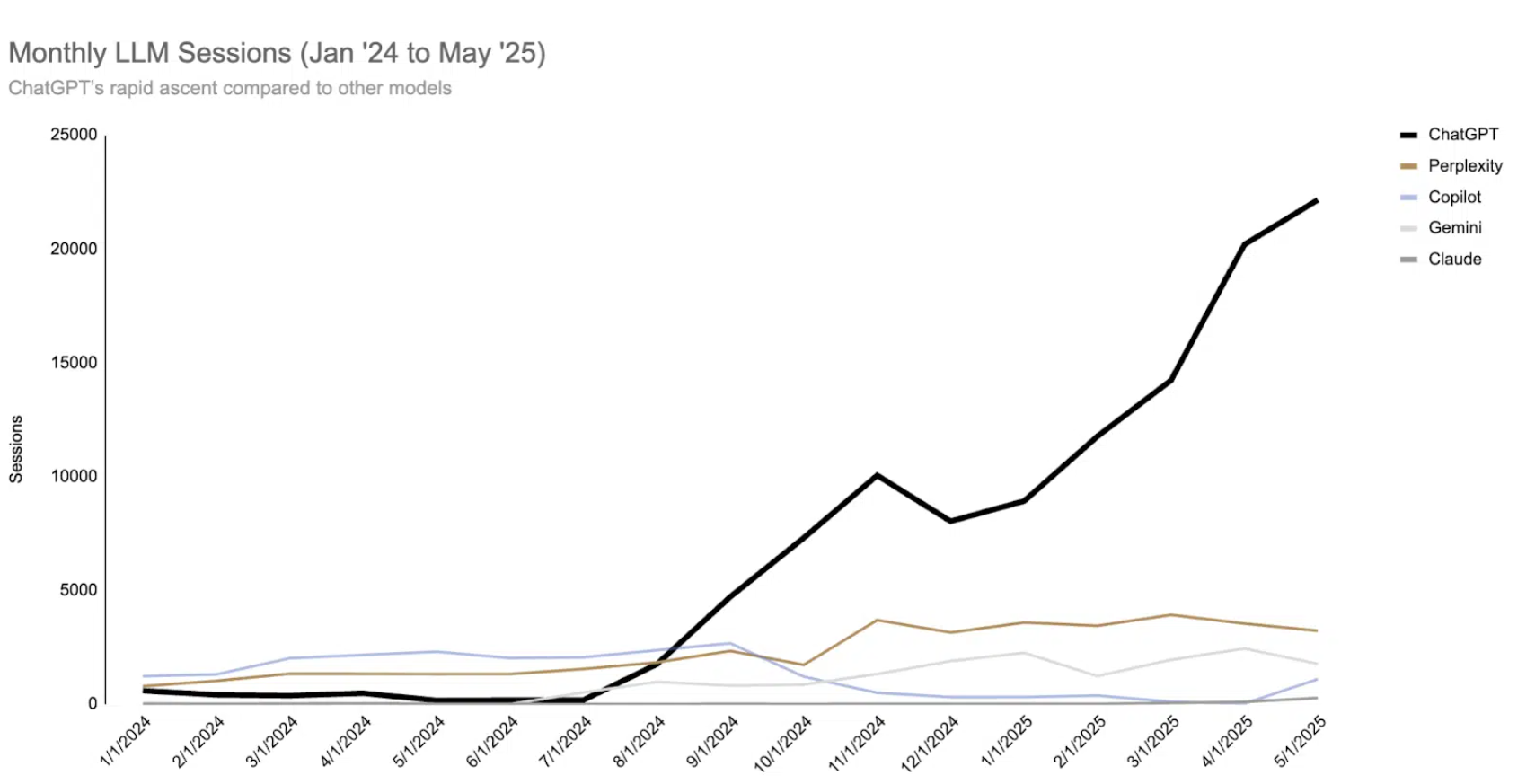
Separate research tracking referral traffic patterns shows that AI-driven sessions experienced a 527% year-over-year increase when comparing the first five months of 2025 with the same period in 2024. For mobile marketers, this means that optimizing solely for App Store or Google Play search is no longer a complete strategy.
Source
Generative Engine Optimization involves structuring your app’s digital presence so that AI systems can accurately understand, verify, and surface it in response to relevant queries. GEO does not replace traditional ASO; it builds on top of it. Strong keyword fundamentals remain essential for store-bound traffic, while GEO extends that foundation into the broader AI-driven discovery ecosystem.
Key Principle: ASO and GEO are complementary disciplines. ASO covers store-bound search. GEO covers the users who start with an AI assistant instead. Both channels matter; neither replaces the other.
How LLMs Evaluate and Retrieve App Information
To optimize effectively for AI, it helps to understand how large language models evaluate and retrieve information. Unlike traditional search engines that match keywords to indexed pages, LLMs operate on semantic similarity. An app’s description is processed as a sequence of tokens, mapped to mathematical vectors, and evaluated for how closely it aligns with the user’s intent.
When descriptions rely heavily on vague marketing language, they tend to produce imprecise vector mappings, making it harder for the model to categorize and recommend the app with confidence. Factual, clearly structured statements improve this semantic alignment.
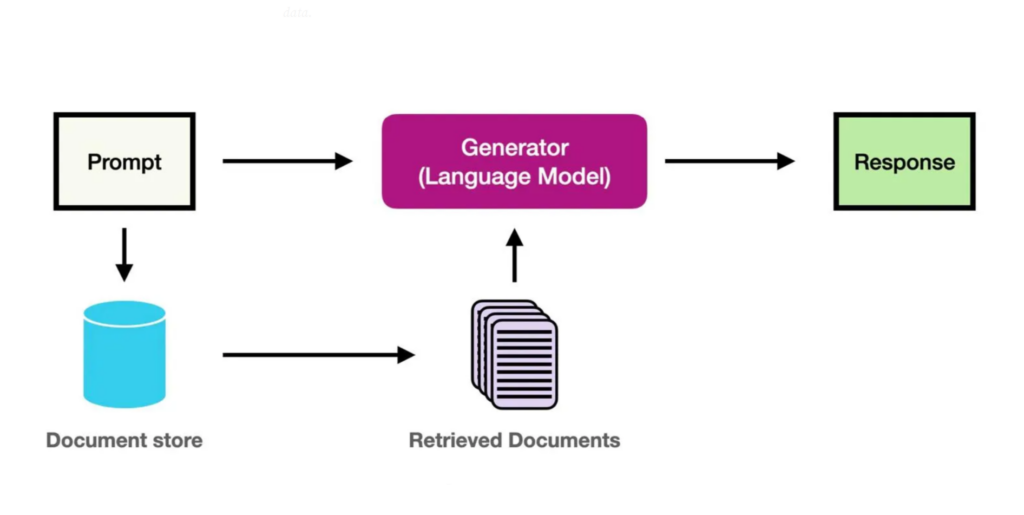
AI systems generally use a two-source process known as Retrieval-Augmented Generation (RAG). The first source is base training data: information absorbed during the model’s initial training. Established apps with years of online coverage benefit here, as their names and functions are already embedded in the model’s weights. The second source is real-time retrieval, where live web queries supplement training data with current information. Newer apps can gain visibility through this channel, provided their content is well-structured and accessible to AI crawlers.
Source
It’s also worth recognizing that the major AI platforms differ meaningfully in how they source and weight information. Google Gemini relies heavily on the Google Index and Knowledge Graph, showing a strong preference for brand-owned, structured content on official websites. ChatGPT, utilizing the Bing Index and its training corpus, synthesizes information from reviews, forums, and comparison content, making community presence highly valuable. Perplexity AI relies on real-time search and explicit citations, meaning authoritative third-party coverage and technical documentation drive visibility on this platform. A well-rounded strategy addresses all three data sources.
Optimizing App Store Metadata for AI
When users interact with AI assistants, they tend to describe their needs in specific, constraint-rich natural language. Rather than searching broadly for “photo editor,” they ask for the “best photo editor for portrait retouching that works offline.” Incorporating these descriptive, problem-centric phrases into your subtitle and opening paragraphs makes it easier for LLMs to match your app to the queries your target users are actually submitting.
A key difference between traditional ASO copy and AI-optimized copy is formatting. LLMs are more effective at extracting specific facts from structured content than from narrative paragraphs. The following comparison illustrates this contrast.
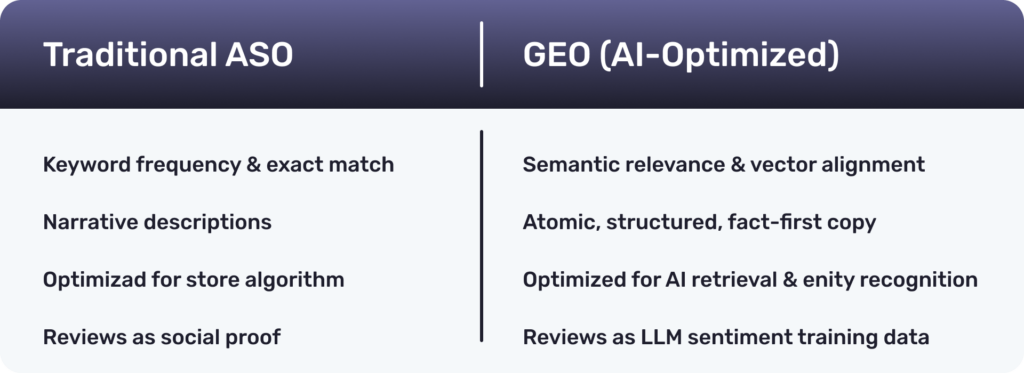
Breaking your content into short, self-contained units (one idea per paragraph, features in lists) makes it significantly easier for AI systems to interpret your metadata accurately.In practice, this means:
- Short, focused paragraphs. Aim for two to three sentences per block, each covering a single concept: one feature, one use case, one integration.
- Direct opening sentences. The first sentence under any heading should address its topic without preamble or build-up.
- Bulleted lists over prose strings. Natural language processing algorithms parse lists significantly more accurately than comma-separated feature strings embedded in a paragraph.
- Structural headings as ranking signals. Content placed directly after a bolded subheading tends to carry more interpretive weight in AI parsing than text appearing mid-paragraph.
Entity Recognition and Knowledge Graphs
For an AI system to reliably recommend an app, the model benefits from recognizing it as a distinct, well-defined entity, a specific product with a known name, purpose, and developer, rather than interpreting it as a loosely related cluster of keywords.
Using the exact same app name, core positioning, and value proposition across the App Store, Google Play, your official website, and social profiles reinforces a clear, unambiguous signal for AI systems. Frequent changes to an app’s title or primary keyword positioning can fragment these signals, making it harder for AI models to maintain a stable and confident understanding of the product.
AI models routinely cross-reference app store metadata with content from official websites, press mentions, and third-party sources. Misalignment between these sources creates conflicting signals. For example, if your website describes your app as a “budget planner” while your App Store listing uses “expense tracker”, an LLM may encounter ambiguity when categorizing the product. Aligning terminology consistently across all platforms supports clearer entity mapping and generally improves the model’s confidence in surfacing your app.
Managing Sentiment and Reviews
User reviews now serve two audiences: the humans reading your store page, and the language models synthesizing recommendations from public data. When an LLM is asked about the strengths or weaknesses of a particular app, it synthesizes information from public reviews rather than testing the product directly. The language patterns found in those reviews actively shape how the AI describes and positions your app to future users.
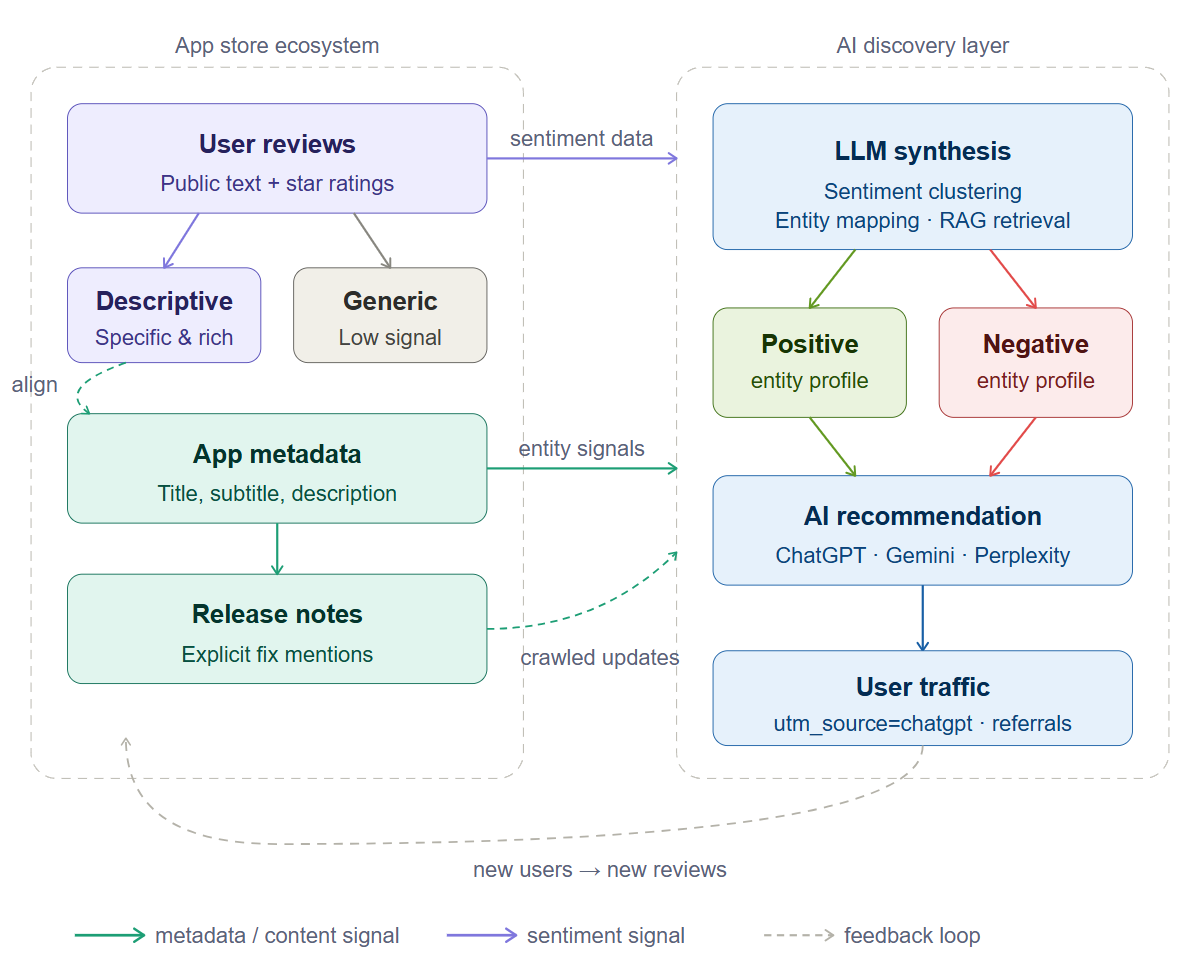
Marketers can use this mechanic constructively by paying attention to the specific phrases satisfied users reach for. If users consistently describe a budgeting tool as a “money lifesaver for couples,” incorporating that phrase into the app’s subtitle or description can create alignment between the metadata and public sentiment — a pattern LLMs tend to weigh favorably.
When recurring issues appear across reviews, they can become part of how AI systems characterize the app. Updating release notes to explicitly mention resolved problems helps signal to both users and AI crawlers that those issues have been addressed. It’s also worth encouraging users to leave specific, descriptive feedback rather than generic praise — contextually rich review text is considerably more useful as an AI input than a single-line rating comment.
A strong, consistent review profile supports both direct store conversion rates and AI-driven discoverability. Keyapp.top’s reputation management service is designed to support the strategic growth of ratings and high-quality reviews, providing AI systems with a meaningful, positive sentiment signal to work from. For a walkthrough of reputation management in practice, watch our video guide.
Integrating The Right Tools
Applying these strategies consistently requires reliable data and the right analytical instruments. While traditional keyword volume metrics remain relevant, marketers working on AI discoverability also need to analyze semantic relevance, competitor entity positioning, and metadata structure.
Keyapp.top provides a suite of free tools designed to support both traditional ASO and the requirements of AI-driven discovery. All three tools, Keyword Finder AI, Keywords Recommended Tool, and the AI Metadata Generator, are free, with no usage limits.Keyword Finder AI. Generates a tailored semantic keyword set based on your app and target market. Provides insight into search popularity, estimated daily traffic, and competitor keyword strategies.
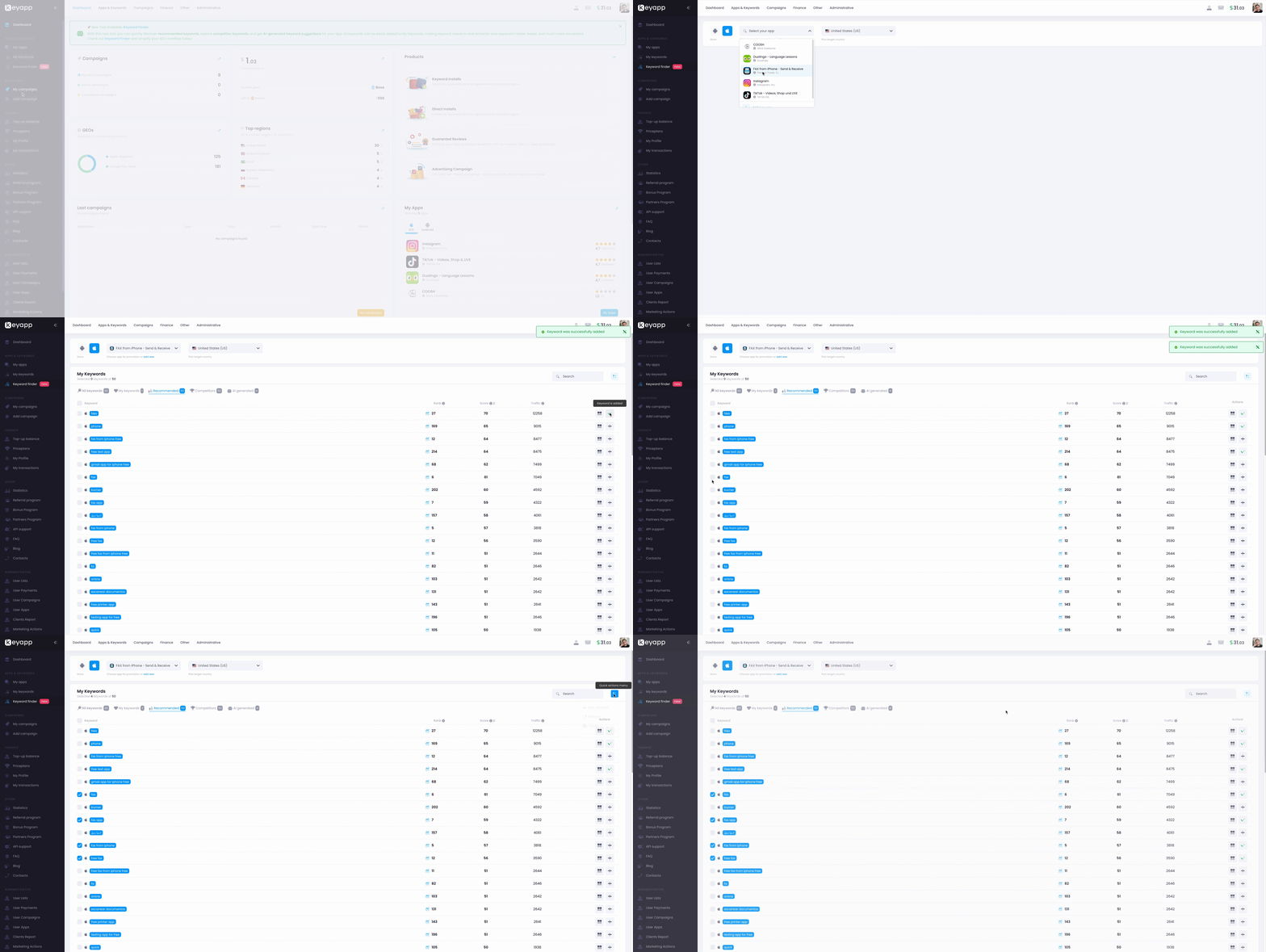
Keywords Recommended Tool. Surfaces related long-tail keyword variations and tracks keyword position movement over time. Useful for establishing baselines before and after metadata changes.
AI Metadata Generator (coming soon). Converts narrative-heavy copy into structured, factual metadata aligned with atomic formatting principles — scannable for human readers and extractable by AI crawlers.
GEO improves AI-layer visibility, but it works best on top of solid store presence. Keyword install campaigns build ranking authority for competitive terms, which also feeds into how AI models assess an app’s relevance.
Conclusion
The shift toward AI-powered app discovery represents a meaningful evolution in how users find and evaluate apps — not a replacement of existing channels, but an addition to them. Effective optimization now involves formatting metadata for machine readability, maintaining consistent entity signals across the web, and actively managing user sentiment so that language models can surface your app with confidence.
For ASO specialists, the near-term action plan is straightforward:
- Restructure your app store descriptions using atomic formatting principles.
- Audit your web presence to ensure terminology aligns consistently with your store listings.
- Monitor how users describe your app in their reviews and reflect that language in your metadata where appropriate.
- Check that AI crawlers can access your official website and that your robots.txt file is not inadvertently blocking them.
AI-driven discovery and traditional store search are most effective when treated as complementary channels. Apps that combine strong keyword visibility with structured, AI-readable metadata are well positioned to capture visibility across both layers.If you’re looking for analytical tools or professional guidance to adapt your app’s growth strategy, the Keyapp.top support team provides ASO tools, keyword installs campaigns, and reputation management services built for this environment.